As April 1 passes and the playful pranks fade away, remember: scammers never take a break.
Spring ushers in a surge of cyberattacks—not because teams are careless, but because the buzz of activity can let even the sharpest employees slip up.
Malicious schemes often camouflage themselves as routine tasks, only revealing their threat once damage is done.
Below are three current scams targeting vigilant employees juggling busy workdays.
Consider this: Would every member of your team spot these threats before it's too late?
Scam #1: Fraudulent Toll or Parking Fee Alerts
An employee receives a text like:
"You owe $6.99 in unpaid tolls. Pay within 12 hours to avoid penalties."
The message references legitimate systems such as E-ZPass, SunPass, or FasTrak, matching the recipient's region. The small amount seems harmless, so amid a busy day, they pay without hesitation.
But the link is fake.
The FBI reports over 60,000 complaints about these fake toll texts in 2024, with a staggering 900% increase in 2025. Scammers have built over 60,000 counterfeit domains mimicking official toll agencies. In some cases, even individuals in toll-free states receive these deceptive texts.
This scam thrives because small charges don't raise suspicion, and recent toll or parking use makes the message feel legitimate.
Protection tip: Authentic toll agencies never demand payment via text links. Instruct your team to always visit official websites or use verified apps directly, and never respond to suspicious messages—even to unsubscribe—as this confirms active numbers to scammers.
Ease tempts; strict procedures protect.
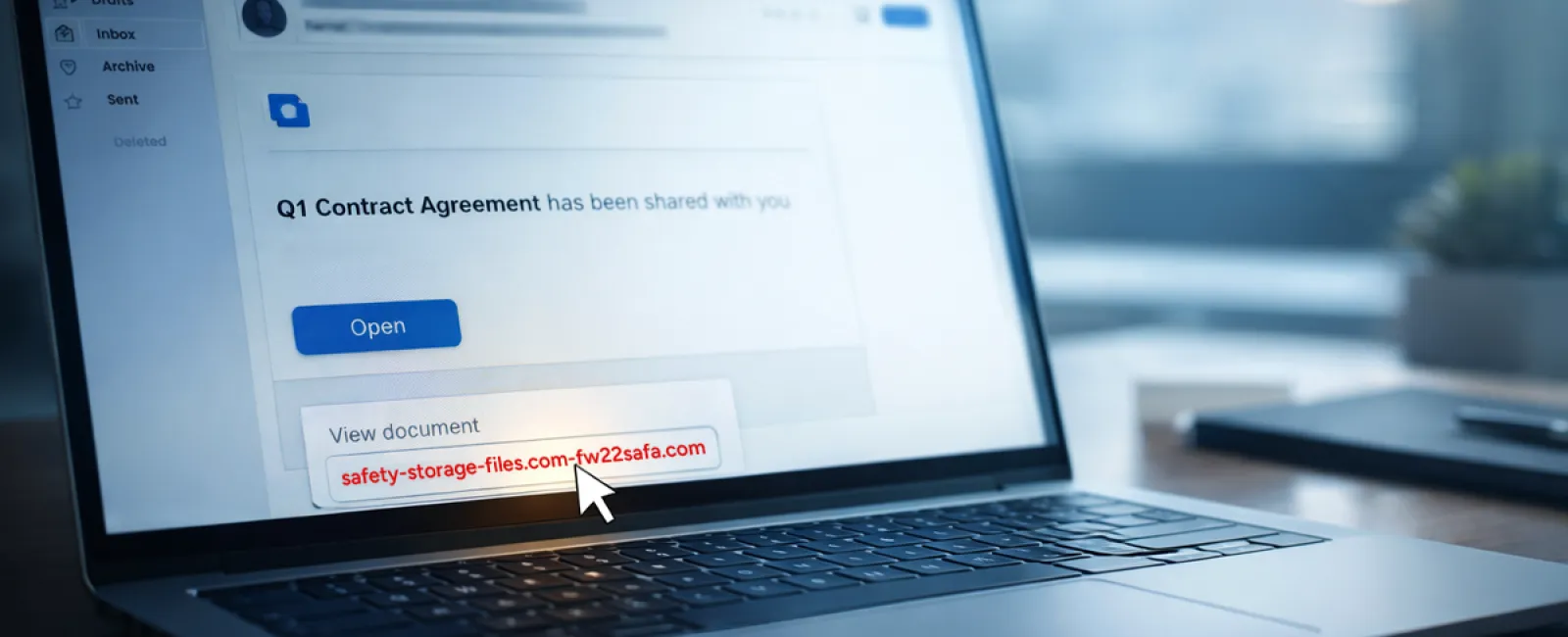
Scam #2: Fake File Sharing Notifications
This scam blends seamlessly into daily workflows.
Employees get emails claiming a document—like a contract in DocuSign or a spreadsheet in OneDrive—has been shared.
The sender's name and formatting look genuine, mimicking trusted platforms perfectly.
Upon clicking, users are prompted to log in, handing over credentials to attackers who then gain access to your company's cloud systems.
Phishing through trusted platforms like Google Drive and Microsoft has surged 67% in 2025, with Google Slides phishing spiking over 200% in six months. Employees are seven times more likely to fall for links on these platforms due to authentic-looking notifications.
Some attackers even use compromised accounts to send real notifications, bypassing spam filters.
Defense strategy: Train your team to avoid clicking unexpected file notifications. Instead, they should log into the platform independently to verify files. Limit external sharing permissions and enable alerts for suspicious logins—settings your IT team can configure quickly.
Consistent caution yields powerful protection.
Scam #3: Sophisticated, AI-Generated Emails
Gone are the days of clumsy phishing emails riddled with mistakes.
AI-crafted scams are highly convincing—even mimicking real company details scraped effortlessly from public sources.
A 2025 study showed AI phishing emails achieve a 54% click rate, over four times higher than human-crafted attempts.
Attacks now target specific departments: HR receives fake employee verifications; finance teams get fraudulent vendor payment requests. One test found 72% engagement with vendor impersonation emails—90% more than other phishing types.
These messages are professional, calm, yet urgent—making them look like typical work communications.
Mitigation advice: Verify all requests involving credentials, payments, or sensitive data through a secondary channel such as a call, chat, or face-to-face confirmation. Encourage employees to hover over sender addresses to check domains and treat any urgent tone as a red flag.
True security never relies on panic.
Key Takeaway
These scams exploit trust, authority, and the notion that "it'll only take a second."
The real vulnerability isn't an inattentive employee but systems that expect perfect decisions under pressure.
If one rushed click could compromise your business, it's not a people problem—it's a process problem.
And process gaps can be fixed.
We're Here to Assist
Business owners often don't want another overwhelming project or the burden of constant cybersecurity training.
They just want confidence that their business is protected.
If you're worried about your team's risks—or know someone who should be—let's talk.
Book a clear, no-pressure discovery call to discuss:
- The top risks businesses like yours face now
- How threats quietly infiltrate everyday work
- Effective ways to reduce risk without slowing your team down
No scare tactics, just practical solutions.
Click here or give us a call at 916-626-4000 to schedule your free 15-Minute Discovery Call.
If this isn't relevant to you, please share it with someone who can benefit—sometimes awareness is all it takes to stop a potential breach.