How Do You Know If Your Business Backups Will Actually Work When You Need Them?
For a business with 20 to 75 employees, seeing a green "backup successful" message isn't enough to prove you can recover after ransomware, hardware failure, accidental deletion, or another serious outage.
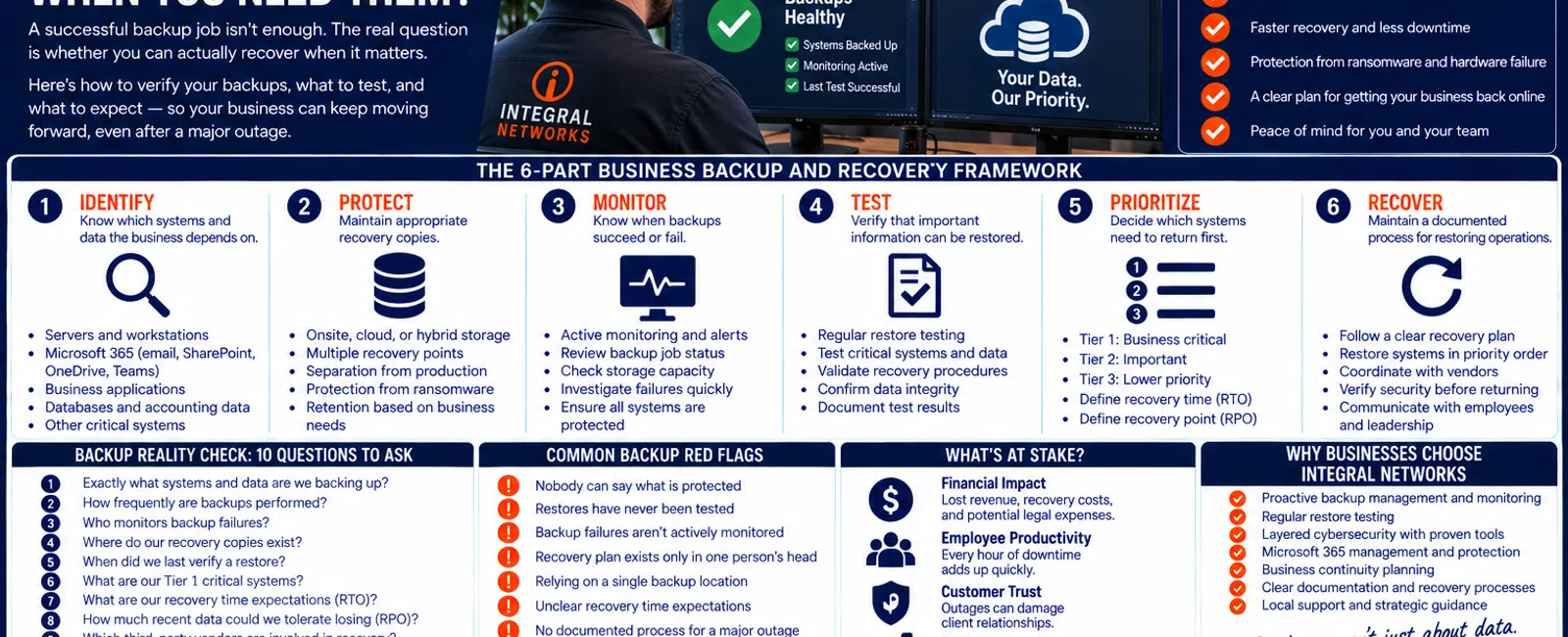
A reliable backup strategy should answer at least six questions: what is protected, how often it's backed up, whether backup jobs are monitored, where recovery copies exist, whether restores have been tested, and how quickly critical systems could reasonably return to operation.
The question leadership should ask isn't:
"Do we have backups?"
It's:
"If something failed today, what could we restore, how would we restore it, and how long would it take?"
Use this six-part framework:
Identify. Protect. Monitor. Test. Prioritize. Recover.
The 6-Part Business Backup and Recovery Framework
A mature backup strategy should include:
1. IDENTIFY — Know which systems and data the business depends on.
2. PROTECT — Maintain appropriate recovery copies.
3. MONITOR — Know when backup jobs succeed or fail.
4. TEST — Verify that important information can actually be restored.
5. PRIORITIZE — Decide which systems need to return first.
6. RECOVER — Maintain a documented process for restoring operations.
A backup product alone doesn't accomplish all six.
Someone needs to manage the recovery strategy.
1. IDENTIFY: What Are You Actually Backing Up?
Start here.
Ask your IT provider:
"Exactly what is protected by our backup systems?"
You should receive a specific answer.
Depending on your organization, critical systems and information may include:
- Servers
- File shares
- Business documents
- Databases
- Accounting information
- Microsoft 365
- SharePoint
- OneDrive
- Business applications
- Industry-specific data
- Other critical systems
Different systems may have different protection methods.
Some applications may be hosted by outside vendors.
Some cloud platforms may provide their own retention or recovery capabilities.
Some systems may require separate backup solutions.
The important thing is knowing.
"Everything Is Backed Up" Isn't a Good Enough Answer
This sounds reassuring:
"Don't worry. We back up everything."
But leadership needs more specificity.
Ask:
Which systems?
Which data?
How frequently?
Where does the recovery copy exist?
Who monitors it?
How would we restore it?
If nobody can answer those questions, you don't have enough visibility into your recovery strategy.
2. PROTECT: Don't Depend on the Same Failure Point
A backup becomes less useful if the event affecting production data can also destroy the recovery copy.
That's why recovery architecture needs separation.
The exact design depends on the environment, but the principle is simple:
Don't make your recovery strategy dependent on the exact same thing you're trying to recover from.
Consider potential events such as:
- Server failure
- Storage failure
- Ransomware
- Credential compromise
- Office disaster
- Accidental deletion
Your provider should understand how the backup architecture responds to the risks relevant to your environment.
Backup Is About More Than Ransomware
Ransomware gets attention.
But businesses recover data for many reasons.
An employee deletes something important.
Hardware fails.
A database becomes corrupted.
An application breaks.
A server fails.
A configuration change causes a problem.
Good backups provide resilience against multiple types of failure.
3. MONITOR: Somebody Has to Watch the Backup System
Backup systems can fail.
Reasons might include:
- Storage capacity
- Credentials
- Connectivity
- Software problems
- Configuration changes
- Device failures
- Other technical issues
If nobody is monitoring the backup system, a problem could exist for days or weeks before anyone notices.
The worst possible time to discover that problem is when you need to restore.
What Should Be Monitored?
Depending on the system, your IT provider should understand:
- Whether expected backup jobs completed
- Whether errors occurred
- Whether protected systems are checking in
- Whether storage capacity is sufficient
- Whether backup failures need investigation
- Whether the expected systems are still protected
A dashboard full of green icons isn't the objective.
Recoverability is the objective.
4. TEST: Backup Success Is Not Restore Success
This is probably the most important concept in the entire article.
A backup can report:
SUCCESS
and still leave important recovery questions unanswered.
The only way to gain confidence in recovery is to verify that important information can actually be restored through an appropriate testing process.
Ask This Question Today
Ask your IT provider:
"When did we last verify a restore?"
Not:
"When did the backup last run?"
Those are different questions.
The appropriate restore-testing method depends on:
- Systems
- Applications
- Backup platform
- Business requirements
- Recovery architecture
But there should be an answer.
What Should Restore Testing Prove?
Depending on the environment, testing may help verify:
- Backup data is accessible
- Expected information exists
- Recovery procedures work
- Critical systems can be restored appropriately
- Documentation is accurate
- Recovery assumptions are realistic
The objective is finding problems during a controlled test—not during an emergency.
5. PRIORITIZE: Not Everything Needs to Recover at the Same Speed
Imagine your entire technology environment becomes unavailable.
What gets restored first?
If your answer is:
"Everything."
that's not a priority list.
Businesses should classify systems according to operational importance.
A simple model is:
TIER 1 — BUSINESS CRITICAL
Systems employees need to perform essential operations.
TIER 2 — IMPORTANT
Systems that significantly affect productivity but may have temporary workarounds.
TIER 3 — LOWER PRIORITY
Systems that can remain unavailable longer without materially preventing core operations.
The exact systems in each category depend on your business.
Why Recovery Priorities Matter
Suppose you have limited recovery resources.
You could spend hours restoring a low-priority application while employees remain unable to access the system they need to serve customers.
That's backwards.
Your IT provider needs business context.
Technology recovery should follow business priorities.
Recovery Time Objective: How Long Can You Be Down?
This leads to an important concept:
Recovery Time Objective — RTO
In practical terms:
How long can this system reasonably remain unavailable?
Different systems may have different answers.
For example, leadership may determine that one critical business application needs a much faster recovery target than an archived data system.
There's no universal RTO appropriate for every business.
The business and IT provider need to discuss it.
Recovery Point Objective: How Much Data Can You Lose?
The second concept is:
Recovery Point Objective — RPO
In practical terms:
How much recent data could the business tolerate losing?
Imagine a system fails at 4:00 PM.
If your most recent recoverable copy is from midnight, that could represent a substantial amount of work.
Again, the appropriate target depends on:
- Application
- Business process
- Data
- Cost
- Technical capabilities
Leadership doesn't need to become an expert in backup terminology.
But it should understand the business decisions behind the recovery design.
6. RECOVER: Have a Process Before You Need It
A backup strategy isn't complete until you know how recovery would actually happen.
Ask:
- Who declares a recovery event?
- Who contacts IT?
- Who coordinates the response?
- Which systems are restored first?
- Which vendors need involvement?
- How will employees communicate?
- What happens if the office is unavailable?
- What happens if Microsoft 365 is affected?
- What happens if credentials are compromised?
- How will leadership receive updates?
You don't need a 200-page binder nobody will read.
You need a process people can actually use.
Backup vs. Disaster Recovery vs. Business Continuity
These terms are related but different.
BACKUP
Creates recoverable copies of data.
DISASTER RECOVERY
Defines how technology systems and information will be restored after a significant failure.
BUSINESS CONTINUITY
Addresses how the organization continues operating during and after disruption.
A business can have excellent backups and still have a weak business-continuity strategy.
That's why recovery planning needs to involve leadership—not only IT.
What Happens During a Ransomware Incident?
Ransomware demonstrates why backup and cybersecurity need to work together.
Imagine malicious activity affects several systems.
The response may require more than:
"Restore yesterday's backup."
Before restoration, the response team may need to understand:
- What happened
- Which systems are affected
- Whether the threat remains active
- Whether credentials are compromised
- Whether the environment is safe for recovery
- Which systems should return first
Restoring into an environment that hasn't been properly assessed may create additional problems.
That's why backup is one part of incident response—not the entire strategy.
Cybersecurity Should Reduce the Chance You Need the Backup
The best recovery event is the one you never need.
That's why Integral Networks uses a layered managed security approach that includes technologies and services such as:
- Microsoft 365 Business Premium
- Avanan email security
- Deep Instinct endpoint protection
- Blokworx managed security services
- Managed patching
- Microsoft 365 security configuration
- Ongoing monitoring
No individual layer prevents every possible incident.
The objective is reducing risk while maintaining recovery capability if prevention fails.
Example: A 50-Person Business
Consider a hypothetical company with 50 employees.
A critical server becomes unavailable at 9:00 AM.
Suppose 25 employees depend heavily on that system.
If those employees lose four productive hours:
25 employees × 4 hours = 100 employee-hours
of disrupted productivity.
That doesn't include:
- Lost revenue
- Customer impact
- Management time
- Recovery costs
- Overtime
- Vendor expenses
Now compare two organizations.
COMPANY A
The backup dashboard showed green yesterday.
But nobody knows:
- When a restore was last tested
- Which recovery copy should be used
- Who owns the process
- How long recovery should take
- Which vendors need involvement
The recovery begins with investigation.
COMPANY B
Critical systems are documented.
Backups are monitored.
Recovery priorities are established.
Restore procedures have been tested appropriately.
Vendors are documented.
Leadership understands the process.
The outage is still a problem.
But the company isn't inventing its recovery strategy while employees wait.
The Cost of One Hour of Downtime
Here's a simple calculation leadership can use.
Suppose 30 employees are unable to work normally for one hour.
That's:
30 employee-hours
of lost productivity.
At two hours:
60 employee-hours.
At four hours:
120 employee-hours.
This doesn't tell you the full financial impact.
But it demonstrates why recovery time matters.
The value of good backup and recovery isn't the backup software.
It's the ability to get people working again.
Microsoft 365 Needs Recovery Planning Too
Many businesses assume cloud services eliminate backup and recovery concerns.
Cloud services improve resilience in many ways.
But leadership still needs to understand recovery options for information stored in platforms such as:
- Exchange Online
- SharePoint
- OneDrive
- Teams
Ask your provider:
"What happens if an employee deletes something important?"
Then:
"What happens if an account is compromised?"
Then:
"What recovery options do we actually have?"
You want specific answers.
Don't Forget Your Business Applications
Many organizations depend on applications managed by outside vendors.
Examples might include:
- Legal applications
- Engineering applications
- ERP systems
- Accounting platforms
- Manufacturing applications
- Financial systems
- Other cloud services
Your MSP may not control the backup architecture for every third-party application.
That's okay.
But someone should document:
- Where the data lives
- Who is responsible for it
- What recovery capabilities exist
- Who to contact
- What your MSP controls
- What the vendor controls
You don't want to discover those boundaries during an outage.
The 10-Question Backup Reality Check
Ask your IT provider:
- Exactly what systems and data are we backing up?
- How frequently are they backed up?
- Who monitors backup failures?
- Where do our recovery copies exist?
- When did we last verify a restore?
- What are our Tier 1 critical systems?
- What are our recovery-time expectations?
- How much recent data could we tolerate losing?
- Which third-party vendors are involved in recovery?
- What happens if ransomware affects multiple systems?
Give yourself one point for every:
"I don't know."
or:
"I'm not sure."
0-2 Points
Leadership appears to have good visibility into backup and recovery.
3-5 Points
Several important areas deserve clarification.
6-10 Points
Your recovery strategy deserves a comprehensive review.
This isn't a technical backup audit.
It's a test of whether the business actually understands how recovery works.
Five Backup Red Flags
1. Nobody Can Say What Is Protected
"Everything" isn't specific enough.
2. Nobody Knows When a Restore Was Tested
Backup completion isn't recovery verification.
3. Failures Aren't Actively Monitored
A failed backup shouldn't remain unnoticed.
4. Nobody Has Defined Recovery Priorities
Your MSP shouldn't decide business priorities during an outage.
5. The Recovery Plan Exists Only in One Person's Head
Important processes should be documented.
What Should Your MSP Be Doing?
For a growing business, backup and recovery should connect to the larger managed IT strategy.
That includes:
IDENTIFY
Understand the systems the business depends on.
PROTECT
Maintain appropriate backup and recovery systems.
MONITOR
Watch for failures and problems.
TEST
Verify recovery capability.
PRIORITIZE
Align recovery with business importance.
RECOVER
Maintain a documented process for restoring operations.
That's a recovery strategy.
Backup and Recovery for Greater Sacramento Businesses
Integral Networks supports growing organizations throughout the Greater Sacramento region, including Sacramento, Roseville, Rocklin, Folsom, Elk Grove, Woodland, Stockton, Modesto, and surrounding communities.
Our primary managed IT focus is businesses with 20 or more employees that need responsive support, cybersecurity, proactive management, backup oversight, and strategic technology planning.
Sacramento, CA: (916) 626-4000
Backup and Recovery for Northern Nevada Businesses
Our second primary service area is Northern Nevada, including Reno, Sparks, Carson City, and surrounding communities.
We combine remote monitoring and management with local onsite capabilities when physical assistance is required.
Reno, NV: (775) 446-4100
Final Thoughts
A successful backup job is good.
A verified recovery strategy is better.
Use the six-part framework:
Identify.
Protect.
Monitor.
Test.
Prioritize.
Recover.
Know what's protected.
Know whether the backup is working.
Verify that you can restore.
Determine what needs to come back first.
Understand realistic recovery expectations.
And document what happens when something goes wrong.
Because during a serious outage, leadership won't care that yesterday's backup dashboard was green.
They'll ask one question:
"When can our people work again?"
Your IT provider should be prepared to answer.
Ready for a Second Opinion?
If you know your company has backups but you're not confident anyone has recently tested recovery—or you're unsure what would actually happen during a ransomware attack, server failure, or major outage—Integral Networks can help evaluate your current backup and recovery strategy.
We provide flat-rate managed IT, cybersecurity, Microsoft 365 management, backup monitoring, recovery planning, documentation, vendor coordination, and strategic IT guidance for growing businesses throughout the Greater Sacramento region and Northern Nevada.
Related Articles
What Should Your IT Provider Do During a Cybersecurity Incident?
What Does Good Cybersecurity Look Like for a 20-75 Employee Business?
What Is Proactive Managed IT—and How Is It Different From Reactive IT Support?
What Should Happen During a Quarterly Business Review With Your IT Provider?
How Much Should a 20-75 Employee Business Budget for IT Each Year?