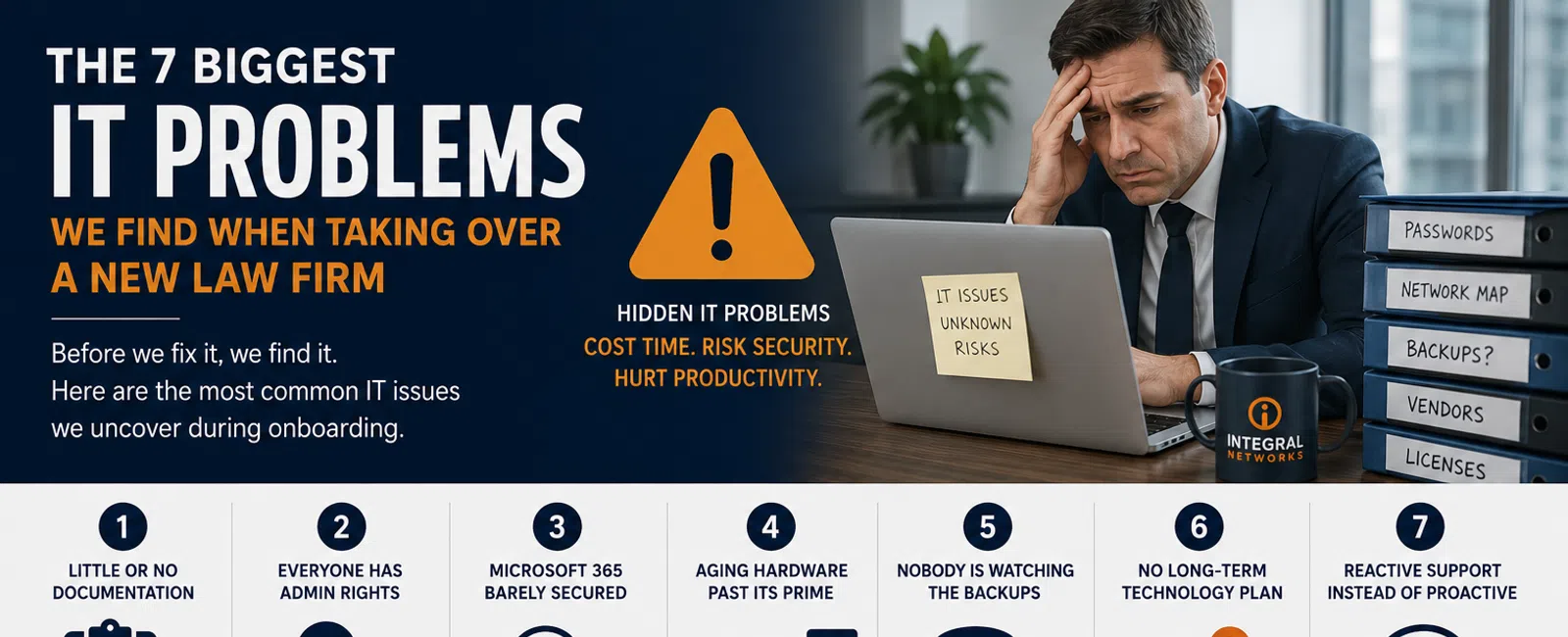
The 7 Biggest IT Problems We Find When Taking Over a New Law Firm
Changing IT providers is often the result of months—or even years—of frustration.
By the time a law firm contacts us, they're rarely looking for "cheaper IT." They're looking for an IT partner that communicates better, responds faster, and takes a proactive approach to managing technology.
After onboarding hundreds of businesses over the years, we've noticed the same patterns appear again and again.
While every environment is unique, these are the seven most common issues we discover when taking over a new law firm.
If you're evaluating your current IT provider, use this list as a health check for your own environment.
Although this article focuses on law firms, these same issues appear regularly when onboarding engineering firms, manufacturers, financial services organizations, and other growing businesses throughout Northern California and Northern Nevada.
1. Little or No Documentation
This is the single biggest problem we encounter.
Many firms have no current network documentation.
Passwords aren't organized.
Firewall configurations are unknown.
Internet providers aren't documented.
Software licensing is incomplete.
Sometimes the previous provider kept all of the documentation. Sometimes it was never created in the first place.
Without documentation, even simple support requests take longer because every technician has to become a detective before solving the problem.
One of the first things Integral Networks does during onboarding is completely document your environment so support becomes faster, more consistent, and less dependent on tribal knowledge.
2. Everyone Has Local Administrator Rights
This is incredibly common.
Employees have administrator rights because "it's easier."
Unfortunately, it's also one of the easiest ways for ransomware and malware to spread throughout a network.
Administrator rights should be granted only when absolutely necessary.
As part of our onboarding process, we review administrative access across the organization and remove unnecessary permissions while ensuring employees can still perform their jobs efficiently.
3. Microsoft 365 Is Barely Secured
Many businesses have already invested in Microsoft 365 Business Premium.
Very few are actually using the security capabilities they're paying for.
Common problems include:
- Multi-factor authentication not enforced
- Legacy authentication still enabled
- Weak password policies
- Excessive administrative accounts
- Security recommendations ignored
- No monitoring of Microsoft 365 activity
During onboarding, we review each client's Microsoft Secure Score and implement security improvements that make sense for their business.
The goal isn't simply achieving a higher score—it's reducing real-world risk.
4. Aging Hardware That's Long Past Its Prime
It's common to find servers or workstations that should have been replaced years ago.
Older hardware increases:
- Downtime
- Security risk
- Employee frustration
- Repair costs
Instead of waiting for equipment to fail unexpectedly, we help clients build technology budgets and replacement schedules that spread costs over time and eliminate surprises.
5. Nobody Is Watching the Backups
One of the most dangerous phrases in IT is:
"I think we're backed up."
Backups should never be based on assumptions.
They should be monitored, tested, and verified.
During onboarding we review backup systems, verify successful jobs, identify failures, and ensure recovery procedures are documented.
A backup that cannot be restored isn't really a backup.
6. No Long-Term Technology Plan
Many businesses receive technical support but very little strategic guidance.
Questions that often go unanswered include:
- When should we replace our computers?
- What's our IT budget next year?
- Should we move additional workloads to the cloud?
- Are we spending too much on software?
- What cybersecurity improvements should come next?
Technology should support business goals—not constantly interrupt them.
That's why every managed client receives ongoing strategic planning, Quarterly Business Reviews, and technology budgeting.
7. Reactive Support Instead of Proactive Management
Perhaps the biggest difference between a traditional IT provider and a true Managed Service Provider is mindset.
Reactive support waits for something to break.
Proactive support works to prevent problems before employees ever notice them.
Continuous monitoring.
Routine maintenance.
Security improvements.
Lifecycle planning.
Vendor management.
Those activities reduce downtime while improving employee productivity.
That's what managed IT is supposed to do.
How We Address These Problems
Every new client follows a structured onboarding process designed to standardize, secure, and document the environment before transitioning into ongoing support.
Our onboarding includes:
- Kickoff meeting
- Network discovery
- Documentation
- Monitoring deployment
- Security standardization
- Microsoft 365 review
- Secure Score remediation
- Final wrap-up meeting
- Transition to proactive support
This process gives both our team and the client confidence that everything starts on a solid foundation.
Final Thoughts
Technology problems rarely happen overnight.
Most organizations slowly accumulate technical debt over several years until everyday tasks become more difficult than they should be.
The good news is that these issues are fixable.
With the right onboarding process, proactive management, and strategic planning, businesses can reduce downtime, improve cybersecurity, and make technology far less stressful.
If several of the problems described above sound familiar, it may be time to evaluate whether your current IT provider is helping your business move forward—or simply reacting when something breaks.
Ready for a Second Opinion?
If you're unsure whether your current IT environment is healthy, we'd be happy to perform a technology assessment and identify opportunities for improvement.
There's no obligation—just practical recommendations based on what we see every day.
Related Articles
How Much Does Managed IT Cost for Law Firms in Northern California? (2026 Pricing Guide)
What's Included in Flat-Rate Managed IT Services? Everything Your Business Should Expect