What Cybersecurity Does an Engineering or Architectural Firm Actually Need?
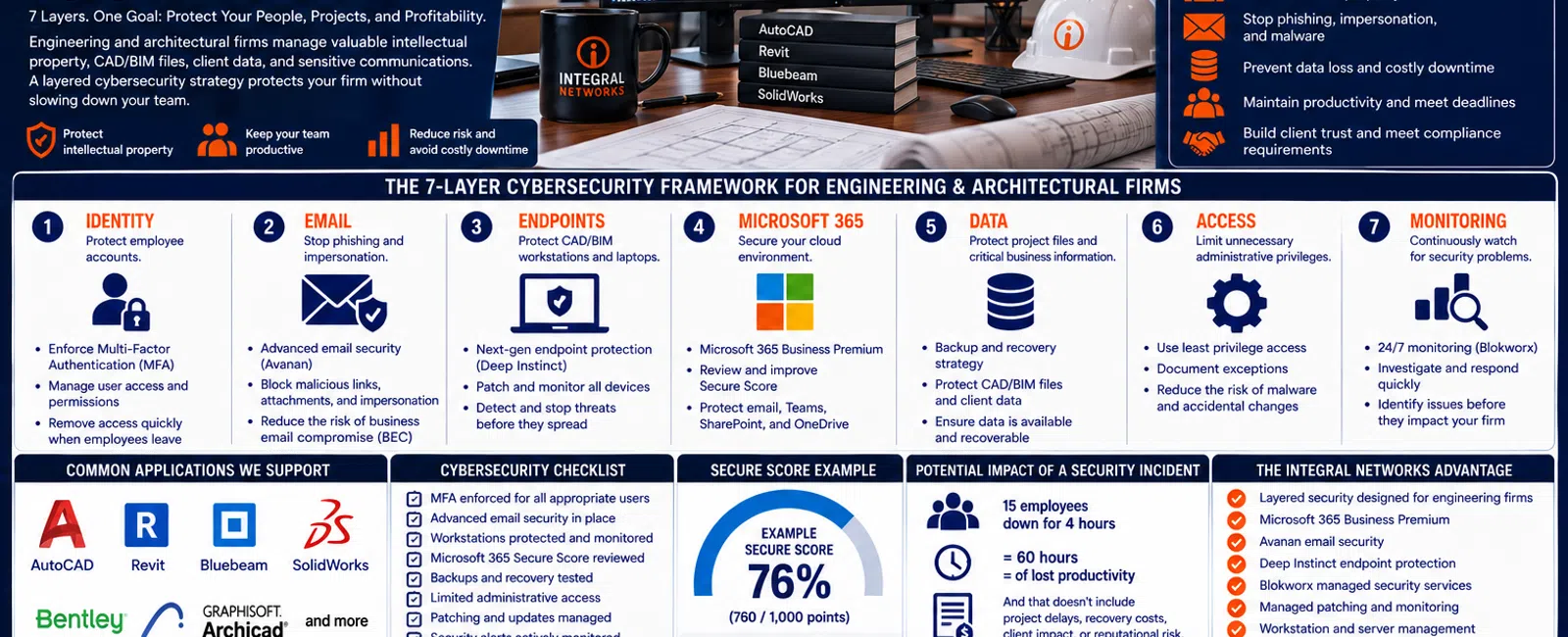
For an engineering or architectural firm with 20 to 75 employees, cybersecurity should protect at least seven areas: identities, email, workstations, Microsoft 365, project data, administrative access, and the overall environment through continuous monitoring.
That doesn't mean buying seven unrelated security products.
It means creating multiple security layers around the technology your architects, engineers, designers, project managers, and administrative employees depend on every day.
For firms using applications such as AutoCAD, Revit, Bluebeam, and SolidWorks, security also needs to account for something equally important:
Your employees still have to get their work done.
The objective isn't maximum restriction.
It's strong security that protects your data without unnecessarily interfering with engineering and design workflows.
For firms throughout the Greater Sacramento region and Northern Nevada, here's the framework we recommend.
The 7-Layer Cybersecurity Framework for Engineering & Architectural Firms
A practical security strategy should protect seven areas:
1. IDENTITY — Protect employee accounts.
2. EMAIL — Stop phishing and impersonation.
3. ENDPOINTS — Protect CAD/BIM workstations and laptops.
4. MICROSOFT 365 — Secure the cloud environment.
5. DATA — Protect project files and critical business information.
6. ACCESS — Limit unnecessary administrative privileges.
7. MONITORING — Continuously watch for security problems.
No single layer is perfect.
That's exactly why you need multiple layers.
1. IDENTITY: Start With the Employee Account
A large amount of modern business technology revolves around identity.
An employee's account may provide access to:
- Microsoft 365
- Teams
- SharePoint
- OneDrive
- Project data
- Business applications
- Cloud services
- Remote resources
If an attacker obtains an employee's password, that identity can become the doorway into several systems.
That's why passwords alone shouldn't be the primary defense.
Multi-Factor Authentication Should Be Enforced
Multi-Factor Authentication adds another verification requirement when someone attempts to access an account.
For a managed environment, MFA shouldn't simply be:
Available.
It should be:
Enforced.
Your IT provider should know which employees are protected, which accounts have exceptions, and why those exceptions exist.
2. EMAIL: Engineering Firms Are Attractive Phishing Targets
Engineering and architectural firms communicate constantly with outside organizations.
That can include:
- Clients
- Contractors
- Subcontractors
- Municipalities
- Consultants
- Vendors
- Suppliers
- Project partners
Attackers can exploit those relationships.
A malicious message may appear to be:
A client sharing project documents.
A Microsoft password notification.
A contractor sending revised plans.
A vendor updating payment instructions.
An executive requesting an urgent transaction.
The more believable the context, the more dangerous the message becomes.
Our Email Security Approach
Integral Networks uses Avanan email security as part of our managed security stack.
The objective is to identify threats such as:
- Phishing
- Impersonation
- Malware
- Malicious attachments
- Credential-stealing links
before employees interact with them whenever possible.
No email security system catches everything.
That's why email protection is one layer—not the entire strategy.
3. ENDPOINTS: Protect the Workstations Doing the Valuable Work
Engineering workstations aren't ordinary office computers.
They may be expensive, powerful systems running applications such as:
- AutoCAD
- Revit
- Bluebeam
- SolidWorks
- Other CAD/BIM and engineering applications
But from a cybersecurity perspective, they're still endpoints.
They may contain or access:
- Project files
- Intellectual property
- Client information
- Credentials
- Business applications
They need active protection.
Integral Networks uses Deep Instinct endpoint protection as part of our standardized managed security approach.
But endpoint protection isn't simply software installation.
Someone needs to verify:
- Protection is deployed.
- Devices are checking in.
- Alerts are reviewed.
- Systems are patched.
- New devices are protected.
- Retired devices are removed.
- Problems are investigated.
Security software nobody actively manages provides false confidence.
4. MICROSOFT 365: Treat It as Security Infrastructure
Most engineering and architectural firms use Microsoft 365 for much more than Word and Excel.
The environment may contain:
- Exchange Online
- Teams
- SharePoint
- OneDrive
- Employee identities
- Company documents
- Client communications
Integral Networks requires Microsoft 365 Business Premium for managed clients because it provides security and management capabilities we use to establish a stronger baseline.
Microsoft Secure Score
During onboarding, we review Microsoft Secure Score and evaluate Microsoft's recommended security improvements.
Secure Score is useful as a framework for identifying configuration opportunities.
The objective isn't chasing a perfect percentage.
It's implementing appropriate controls based on the firm's actual environment and business requirements.
5. DATA: Protect the Project Files the Business Depends On
For an engineering or architectural firm, project data may represent thousands of hours of professional work.
That can include:
- CAD drawings
- Revit models
- Bluebeam files
- Specifications
- Engineering calculations
- Client documents
- Project correspondence
- Images
- Contracts
- Other intellectual property
Cybersecurity therefore isn't simply about preventing someone from stealing data.
It's also about maintaining the availability and integrity of that information.
If project files suddenly become unavailable, productivity can stop even if no information was stolen.
Backups Matter
Your organization should understand:
- What is being backed up
- How often
- Where recovery copies exist
- Who monitors failures
- How critical information would be restored
The correct question isn't:
"Do we have backups?"
It's:
"Could we recover the project data our employees need?"
6. ACCESS: Everyone Shouldn't Have Administrator Rights
This is one of the most common problems we encounter in poorly managed environments.
Employees have administrator rights because:
"They need to install AutoCAD updates."
or:
"That application requires it."
or simply:
"That's how we've always done it."
Engineering applications can absolutely create legitimate technical requirements.
But those requirements should be understood and documented.
They shouldn't automatically result in everyone having unrestricted administrative access.
Use Least Privilege
The principle is simple:
Give employees the access required to perform their jobs—and no more.
If someone requires elevated privileges for a legitimate workflow, your IT provider should understand why and determine the appropriate way to handle it.
Convenience shouldn't silently become your security policy.
7. MONITORING: Somebody Has to Watch the Security Tools
This is where cybersecurity programs sometimes break down.
A business buys:
- Antivirus
- Email filtering
- Microsoft 365 security
- Backup
- Other tools
Everything gets installed.
Then everyone assumes the environment is secure.
But security systems generate alerts.
Devices change.
Employees change.
Accounts change.
New threats appear.
Someone needs to be paying attention.
Integral Networks utilizes Blokworx managed security services as part of our layered security model.
Combined with Microsoft 365 Business Premium, Avanan, Deep Instinct, managed patching, Microsoft 365 configuration, and ongoing IT management, this provides multiple layers of protection and monitoring.
What About CAD/BIM Performance?
This is where engineering cybersecurity becomes more complicated.
An engineer complains:
"Security software is slowing down Revit."
The easy response is:
Disable security.
That's rarely the right first answer.
Instead, determine:
- Is security actually causing the problem?
- Is the workstation appropriately sized?
- Is the application configured correctly?
- Is storage slow?
- Is the network the bottleneck?
- Does the application require a documented security exception?
This connects directly to the troubleshooting framework we covered in Article #23.
Diagnose first. Change security second.
Performance problems should be investigated rather than used as a blanket justification for weakening protection.
Patching Requires More Thought in Engineering Environments
Patching is another area where engineering firms can have legitimate concerns.
An operating-system update, application update, graphics driver, or other change could potentially affect specialized software.
That doesn't mean:
Never update anything.
It means updates need to be managed deliberately.
Your IT provider should understand:
- Which applications are business-critical
- Which systems have dependencies
- Which vendors need involvement
- Which updates require testing or planning
- Which vulnerabilities need prompt attention
Ignoring updates indefinitely creates security risk.
Applying every change without understanding the business environment can create operational risk.
Good IT management balances both.
The Security vs. Productivity Balance
Imagine two extremes.
Firm A: Almost No Restrictions
Everyone has administrator rights.
Employees install whatever they want.
Security configuration is inconsistent.
Updates happen randomly.
Employees have maximum flexibility.
The firm also has unnecessary security exposure.
Firm B: Security Above Everything
Applications are heavily restricted.
Employees can't perform ordinary tasks.
Engineering workflows constantly break.
Every exception requires an IT escalation.
Security has begun interfering with the firm's ability to produce work.
Neither is the objective.
Firm C: Managed Security
Applications and workflows are understood.
Security standards are established.
Exceptions are documented when genuinely necessary.
Employees receive the access they need.
Security controls are actively monitored.
That's the balance we're trying to create.
What Does Downtime Cost an Engineering Firm?
Consider a 40-person engineering firm.
Suppose a cybersecurity incident prevents 15 employees from working normally for four hours.
That's:
15 employees × 4 hours = 60 employee-hours
of lost productivity.
And that doesn't include:
- Project delays
- Missed deadlines
- Recovery costs
- Management time
- Vendor coordination
- Potential client impact
Now consider a more serious incident that affects the entire organization for a full day.
The productivity cost increases quickly.
That's why cybersecurity isn't simply an IT expense.
It's part of protecting the firm's ability to deliver professional work.
A Hypothetical Phishing Attack
Consider a 30-person architectural firm.
A project manager receives an email that appears to come from a project partner.
The message says:
"Here are the revised drawings we discussed."
There's a link.
The employee clicks it.
They're presented with what appears to be a Microsoft login page.
They enter their credentials.
Now consider the layers.
Email Security
Avanan may identify and block the phishing message.
Identity
MFA may prevent the stolen password alone from providing access.
Endpoint Protection
Deep Instinct provides another security layer on the workstation.
Microsoft 365 Security
Microsoft security controls may identify suspicious activity.
Monitoring
Security monitoring provides another opportunity to detect abnormal behavior.
Employee Awareness
The employee may recognize something unusual and contact IT before proceeding.
The strategy doesn't assume any one layer will always succeed.
It gives the attack multiple opportunities to fail.
The 10-Question Engineering Firm Cybersecurity Check
Ask these questions:
- Is MFA enforced for appropriate employees?
- Do we use advanced email security?
- Are all supported workstations protected and monitored?
- Is Microsoft 365 actively secured and managed?
- Has Microsoft Secure Score been reviewed?
- Do we know exactly who has administrator rights?
- Are operating systems and applications patched consistently?
- Are critical project files backed up appropriately?
- Are security alerts actively monitored?
- Can our IT provider explain our security strategy in plain English?
Give yourself one point for every:
"No"
or:
"I'm not sure."
0-2 Points
Many foundational controls appear to be in place.
3-5 Points
There are meaningful areas worth reviewing.
6-10 Points
Your firm's security environment deserves a comprehensive review.
This isn't a formal cybersecurity assessment.
It's a way for leadership to identify questions that should have clear answers.
Cybersecurity and Employee Onboarding
Security also begins when an employee joins the company.
New employees may need:
- Microsoft 365
- Workstation access
- Project files
- AutoCAD
- Revit
- Bluebeam
- SolidWorks
- Network resources
- Cloud applications
Those permissions should follow a repeatable process.
The same is true when an employee leaves.
Offboarding should address:
- Microsoft 365
- Business applications
- Project access
- Remote access
- Administrative privileges
- Company equipment
- Other accounts
Former employees shouldn't retain access because nobody remembered a system.
Documentation Is Part of Cybersecurity
A security incident is a terrible time to discover nobody knows how the environment works.
Your IT provider should maintain documentation covering important areas such as:
- Workstations
- Servers
- Network equipment
- Microsoft 365
- Security tools
- Backup
- Administrative access
- Application vendors
- Project-data locations
- Important technology dependencies
Documentation makes both support and incident response faster.
What Should Your MSP Be Providing?
For a 20-75 employee engineering or architectural firm, cybersecurity should be connected to the larger managed IT relationship.
That means:
PROTECT
Layered security across identities, email, endpoints, Microsoft 365, and data.
MANAGE
Patch, monitor, document, and maintain the environment.
SUPPORT
Understand CAD/BIM applications and employee workflows.
RECOVER
Maintain and monitor appropriate backup and recovery systems.
PLAN
Review security risks and future improvements as part of the technology roadmap.
Security shouldn't exist in a silo.
Cybersecurity for Engineering & Architectural Firms in Greater Sacramento
Integral Networks supports engineering and architectural firms throughout the Greater Sacramento region, including Sacramento, Roseville, Rocklin, Folsom, Elk Grove, Woodland, Stockton, Modesto, and surrounding communities.
Our primary focus is organizations with 20 or more employees that depend heavily on technology to deliver professional work.
Sacramento, CA: (916) 626-4000
Cybersecurity for Engineering & Architectural Firms in Northern Nevada
Our second primary service area is Northern Nevada, including Reno, Sparks, Carson City, and surrounding communities.
We combine remote monitoring, managed cybersecurity, and technical support with local onsite capabilities when physical assistance is required.
Reno, NV: (775) 446-4100
Final Thoughts
Cybersecurity for an engineering or architectural firm isn't simply antivirus.
And it shouldn't be a collection of unrelated products accumulated over time.
Build seven layers:
Identity.
Email.
Endpoints.
Microsoft 365.
Data.
Access.
Monitoring.
Then manage those layers around the way your employees actually work.
Protect the firm's information.
Protect the workstations.
Protect Microsoft 365.
Protect project data.
But don't lose sight of the ultimate objective:
Your architects and engineers still need to design, collaborate, meet deadlines, and serve clients.
Good cybersecurity should help protect that work—not unnecessarily get in its way.
Ready for a Second Opinion?
If you're not sure whether your engineering or architectural firm's cybersecurity is properly protecting Microsoft 365, CAD/BIM workstations, project data, email, and employee accounts, Integral Networks can review the current environment and identify areas where risk could be reduced.
We provide flat-rate managed IT, cybersecurity, Microsoft 365 management, workstation management, infrastructure monitoring, vendor coordination, and strategic technology planning for engineering and architectural firms throughout the Greater Sacramento region and Northern Nevada.
Related Articles
Why Are AutoCAD, Revit, Bluebeam, or SolidWorks Running Slow at Our Engineering Firm?
The 7 Biggest IT Problems We Find at Engineering & Architectural Firms
How Secure Should Microsoft 365 Be for a 20-75 Employee Business?
What Does Good Cybersecurity Look Like for a 20-75 Employee Business?