How Should Engineering and Architectural Firms Manage High-Performance Workstations and CAD Software?
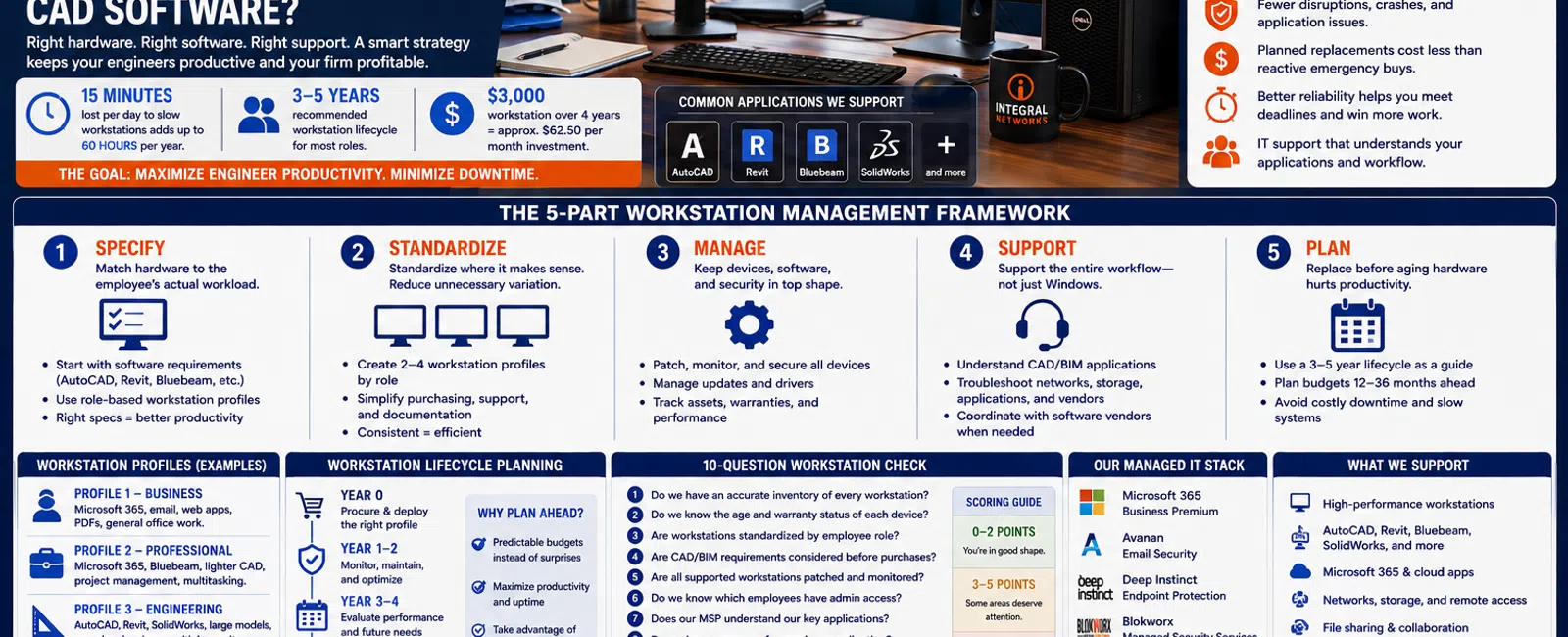
For an engineering or architectural firm with 20 to 75 employees, workstation management should be based on employee role, application requirements, hardware performance, standardization, and a planned 3-5 year lifecycle—not simply buying the same computer for everyone or waiting until equipment fails.
An administrative employee working primarily in Microsoft 365 doesn't have the same hardware requirements as an engineer working in AutoCAD, Revit, Bluebeam, or SolidWorks.
And a powerful workstation alone doesn't solve the problem.
Your IT provider needs to manage the complete environment around it: hardware, software, security, updates, networks, file access, vendors, documentation, and lifecycle planning.
Here's the framework we recommend.
The 5-Part Workstation Management Framework
Engineering and architectural firms can evaluate workstation management using five areas:
1. SPECIFY — Match hardware to the employee's actual workload.
2. STANDARDIZE — Reduce unnecessary hardware and configuration variations.
3. MANAGE — Maintain devices, software, security, and performance.
4. SUPPORT — Troubleshoot the entire workflow, not just Windows.
5. PLAN — Replace equipment before aging hardware becomes a productivity problem.
Let's look at each one.
1. SPECIFY: Don't Buy Every Employee the Same Computer
One of the first mistakes firms can make is standardizing on a single computer specification for every employee.
Standardization is valuable.
But that doesn't mean everyone needs identical hardware.
Consider three employees.
Employee A: Administrative
Primarily uses:
- Outlook
- Word
- Excel
- Teams
- Browser-based applications
- PDFs
Employee B: Project Manager
May regularly use:
- Microsoft 365
- Bluebeam
- AutoCAD
- Project-management applications
- Large documents
- Multiple monitors
Employee C: Engineer or Designer
May depend heavily on:
- AutoCAD
- Revit
- SolidWorks
- Large models
- Complex drawings
- Rendering or other compute-intensive workloads
Those are three different workloads.
Buying Employee C an ordinary office computer can hurt productivity.
Buying Employee A an extremely expensive engineering workstation may simply waste money.
What Better IT Looks Like
Develop 2-4 standardized workstation profiles based on employee roles.
For example:
Profile 1 — Business
General Microsoft 365 and administrative work.
Profile 2 — Professional
Project management, Bluebeam, lighter CAD usage, and heavier multitasking.
Profile 3 — Engineering
AutoCAD, Revit, SolidWorks, and demanding project workloads.
Profile 4 — Specialized
High-end rendering, simulation, unusually large projects, or other exceptional requirements.
The exact specifications will change over time.
The framework doesn't.
2. SPECIFY: Start With the Software Requirements
Don't begin workstation purchasing with:
"Which Dell or HP is on sale?"
Start with:
"What does this employee actually need to run?"
Software vendors publish system requirements and recommendations for their applications.
Those requirements can change between versions.
Applications may place different demands on:
- Processor
- Memory
- Graphics
- Storage
- Operating system
- Display configuration
A workstation should therefore be selected based on the employee's actual application mix.
Minimum Requirements Aren't Always the Right Target
There's also a difference between:
Can the software run?
and:
Can the employee work efficiently all day?
For a professional whose labor is expensive and often billable, buying hardware that merely meets the minimum specification can be false economy.
3. STANDARDIZE: Too Many Configurations Make Support Harder
There's a balancing act.
You don't want every employee using identical hardware regardless of role.
But you also don't want 40 completely different computer configurations.
Excessive variation creates problems.
Technicians encounter different:
- Drivers
- Hardware
- Graphics configurations
- Software versions
- Peripheral setups
- Performance characteristics
Troubleshooting becomes slower.
Purchasing becomes inconsistent.
Replacement planning becomes more complicated.
Use Role-Based Standards
That's why we prefer a small number of standardized workstation profiles.
You still match performance to the job.
But you reduce unnecessary variation.
This makes:
- Purchasing easier
- Support easier
- Documentation easier
- Replacement planning easier
- Employee onboarding easier
Standardization should simplify the environment without ignoring legitimate engineering requirements.
4. MANAGE: High-Performance Computers Still Need Security
An expensive engineering workstation is still an endpoint.
It needs to be:
- Patched
- Monitored
- Secured
- Documented
- Managed
Performance requirements shouldn't become an excuse for weak cybersecurity.
At Integral Networks, our managed security approach includes technologies and services such as:
- Microsoft 365 Business Premium
- Deep Instinct endpoint protection
- Avanan email security
- Blokworx managed security services
- Managed patching
- Microsoft 365 security configuration
- Ongoing monitoring
The specific configuration needs to account for the employee's applications and workflow.
Security needs to protect the workstation without unnecessarily interfering with engineering productivity.
5. MANAGE: Administrator Rights Need Attention
This can become particularly important in engineering environments.
Users sometimes have local administrator rights because:
"The software needs it."
Or:
"They have to install updates."
Or:
"We've always done it this way."
Sometimes specialized software genuinely creates unusual requirements.
But broad administrative access shouldn't be granted automatically without understanding why it's necessary.
Better Approach
Ask:
- Does the employee actually need administrator access?
- Does the application require it?
- Is there another way to handle updates?
- Can elevated privileges be limited?
- Is the exception documented?
The principle remains:
Give users the access they need to do their jobs—and no more than they need.
6. SUPPORT: Your MSP Needs to Understand the Workflow
Your MSP doesn't need to replace Autodesk, Bluebeam, Dassault Systèmes, or every specialized application vendor.
But it needs to understand how the firm's technology works together.
Suppose Revit performance suddenly becomes terrible.
The cause could potentially involve:
- The workstation
- Network connectivity
- Storage
- Application configuration
- Project files
- Software
- A vendor-controlled component
Simply saying:
"That's a Revit problem. Call Autodesk."
isn't much of a support experience.
What Better Support Looks Like
Your MSP should help determine where the problem exists.
If another vendor needs to become involved, the MSP should help coordinate the technical conversation.
Your engineers shouldn't have to spend hours determining which vendor owns the problem.
7. SUPPORT: File Performance Matters as Much as Computer Performance
A high-performance workstation can't compensate for slow access to project data.
Engineering and architectural firms may work with large:
- CAD files
- Revit models
- PDFs
- Project folders
- Images
- Shared data
That means workstation performance is connected to the rest of the environment.
Your IT provider needs to consider:
- Network performance
- Storage
- Internet connectivity
- Remote access
- Cloud applications
- File-sharing architecture
- Backup
- Collaboration requirements
A $4,000 workstation connected to a poorly performing infrastructure can still deliver a frustrating experience.
8. PLAN: Use a 3-5 Year Workstation Lifecycle as a Starting Framework
Computers don't suddenly become old on a specific birthday.
A 3-5 year lifecycle is a planning framework, not a rule that every computer must be replaced at exactly the same age.
Actual replacement timing depends on:
- Employee role
- Hardware specification
- Application requirements
- Performance
- Warranty
- Reliability
- Business requirements
Engineering workstations may justify a different lifecycle than administrative computers.
The important thing is that replacement timing is planned.
Why Waiting for Failure Is Expensive
Suppose an engineer's workstation becomes increasingly slow.
They lose just 15 minutes per day waiting on technology.
Over approximately 240 working days:
15 minutes × 240 days = 60 hours per year.
That's 60 hours of lost productivity from one employee.
Now multiply that across several engineers.
Suddenly, delaying a workstation replacement to save money may be costing considerably more than the new computer.
This is why workstation decisions should consider employee productivity—not just hardware price.
Example: Planning Workstations for a 40-Person Engineering Firm
Consider a hypothetical 40-person engineering firm.
Its inventory might include:
- 10 administrative/business workstations
- 12 professional/project-management workstations
- 16 engineering workstations
- 2 specialized high-performance systems
Instead of replacing equipment randomly, the firm maintains:
- Purchase date
- User
- Workstation profile
- Warranty
- Age
- Application requirements
- Expected replacement year
Suppose eight systems are approaching replacement next year.
Leadership knows that before the annual budget is finalized.
That's dramatically better than eight employees showing up over six months saying:
"My computer is too slow."
9. PLAN: Hardware and Software Planning Need to Work Together
Workstation lifecycle planning can't happen independently of software planning.
Suppose the next version of a critical application changes its hardware requirements.
Or the firm plans to adopt a new design application.
Or project sizes are increasing.
That may change the workstation strategy.
Your MSP should therefore communicate with:
- Leadership
- Engineering management
- Application vendors
- Employees where appropriate
Technology planning should follow the firm's actual business requirements.
10. PLAN: Budget for Workstations Before You Need Them
If a firm needs to replace 10 engineering workstations next year, that shouldn't be an unexpected expense.
Asset lifecycle planning should give leadership visibility 12-36 months ahead.
At Integral Networks, strategic IT management includes:
- Asset management
- Hardware lifecycle planning
- Technology budgeting
- Quarterly Business Reviews
- Vendor management
- Technology roadmaps
- vCIO guidance
The objective isn't predicting the exact cost of every computer three years from now.
It's making sure leadership knows significant technology investments are coming.
The Workstation Cost vs. Productivity Calculation
Here's a useful way to think about workstation spending.
Suppose a replacement workstation costs $3,000.
Assume the employee uses it for four years.
That's approximately:
$750 per year
or roughly:
$62.50 per month
before considering financing, support, taxes, or other costs.
Now compare that with the cost of a highly paid professional losing productive time every day because their workstation is underpowered.
The workstation is a tool.
For an engineer, architect, or designer, it may be one of the most important productivity tools they use.
The cheapest workstation isn't necessarily the least expensive choice.
A 10-Question Engineering Workstation Health Check
Ask these questions:
- Do we have an accurate inventory of every workstation?
- Do we know the age and warranty status of each device?
- Are workstations standardized by employee role?
- Are CAD/BIM requirements considered before hardware purchases?
- Are all supported workstations patched and monitored?
- Do we know which employees have administrator access?
- Does our MSP understand AutoCAD, Revit, Bluebeam, SolidWorks, and our other primary applications?
- Do we have a process for coordinating with application vendors?
- Do we know which workstations should be replaced over the next 12-36 months?
- Are those replacements included in the technology budget?
Give yourself one point for every "No" or "I'm not sure."
0-2 Points
Your workstation-management process appears relatively mature.
3-5 Points
There are meaningful opportunities to improve standardization or planning.
6-10 Points
Your firm is probably managing workstations more reactively than it should.
This isn't a formal engineering-workstation assessment.
It's a framework for identifying where better IT management could improve productivity and predictability.
What Should Your Managed IT Provider Actually Do?
For engineering and architectural firms, workstation management should connect five functions.
SPECIFY
Match hardware to employee requirements.
STANDARDIZE
Create repeatable workstation profiles.
MANAGE
Patch, secure, monitor, and document devices.
SUPPORT
Understand the applications and infrastructure employees depend on.
PLAN
Forecast replacements and budget for them.
That's the difference between:
Buying computers
and:
Managing a workstation lifecycle.
Managed IT for Engineering & Architectural Firms in Greater Sacramento
Integral Networks supports engineering and architectural firms throughout the Greater Sacramento region, including Sacramento, Roseville, Rocklin, Folsom, Elk Grove, Woodland, Stockton, Modesto, and surrounding communities.
Our primary focus is organizations with 20 or more employees that depend heavily on technology for professional work.
Sacramento, CA: (916) 626-4000
Managed IT for Engineering & Architectural Firms in Northern Nevada
Our second primary service area is Northern Nevada, including Reno, Sparks, Carson City, and surrounding communities.
We combine remote monitoring and support with local onsite capabilities when physical assistance is necessary.
Reno, NV: (775) 446-4100
Final Thoughts
Engineering and architectural firms shouldn't manage high-performance workstations the same way ordinary office computers are managed.
But they also shouldn't treat every workstation as a completely unique technology project.
Use the five-part framework:
Specify.
Standardize.
Manage.
Support.
Plan.
Match the hardware to the employee.
Standardize where practical.
Protect and monitor the device.
Understand the applications surrounding it.
And replace equipment according to a planned lifecycle instead of waiting for failure.
For a 20-75 employee firm, that creates a technology environment that's easier to support, easier to budget, and better aligned with the professionals using it.
Because the objective isn't having the cheapest computers.
It's giving your employees technology that helps them do valuable work efficiently.
Ready for a Second Opinion?
If your engineering or architectural firm is struggling with aging workstations, inconsistent hardware, CAD/BIM performance, recurring application problems, or unpredictable replacement costs, Integral Networks can review your current environment and help build a more structured workstation lifecycle.
We provide flat-rate managed IT, cybersecurity, Microsoft 365 management, workstation lifecycle planning, vendor coordination, and strategic IT guidance for engineering and architectural firms throughout the Greater Sacramento region and Northern Nevada.
Related Articles
How Much Does Managed IT Cost for Engineering & Architectural Firms? 2026 Pricing Guide
The 7 Biggest IT Problems We Find at Engineering & Architectural Firms
Why Engineering & Architectural Firms Need More Than Just an IT Company
How Much Should a 20-75 Employee Business Budget for IT Each Year?
How Long Should It Take Your IT Provider to Respond to a Support Request?