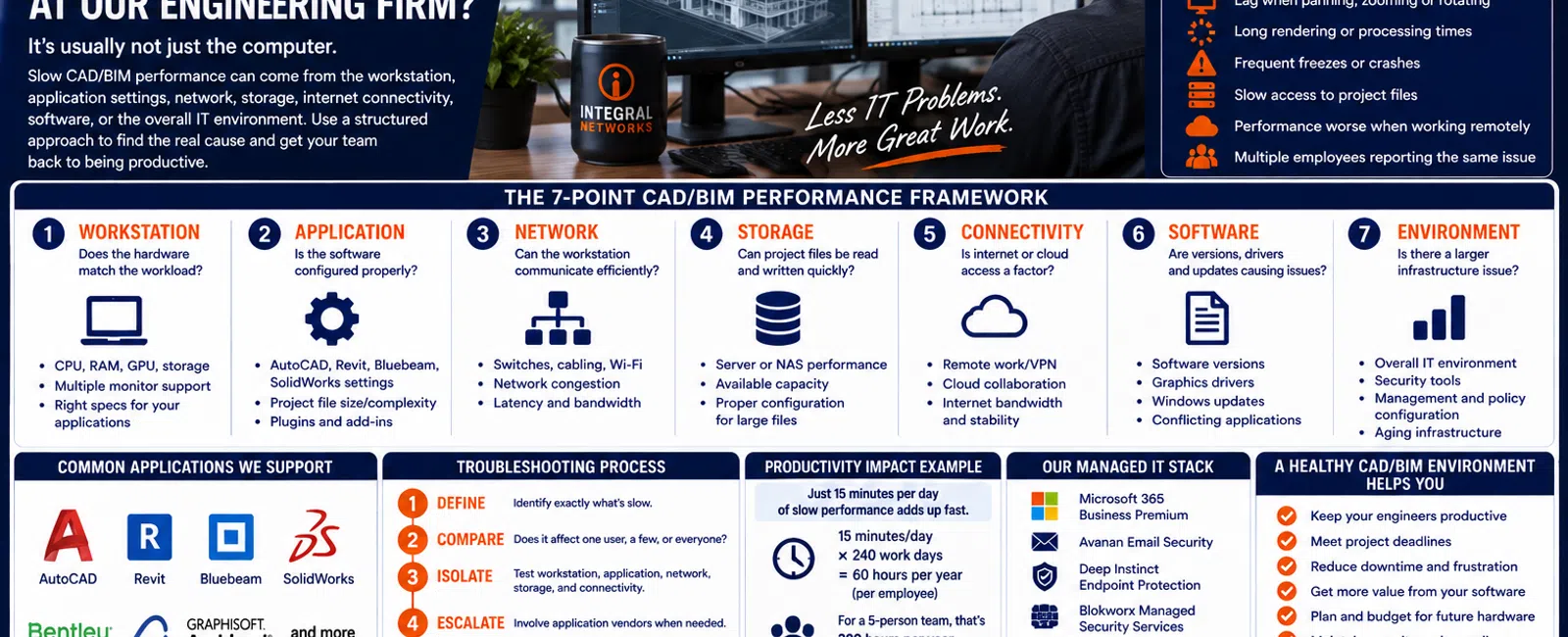
Why Are AutoCAD, Revit, Bluebeam, or SolidWorks Running Slow at Our Engineering Firm?
When AutoCAD, Revit, Bluebeam, SolidWorks, or another design application starts running slowly, don't automatically blame the workstation.
For an engineering or architectural firm with 20 to 75 employees, poor application performance can come from at least 7 different areas: the workstation, application configuration, network, file storage, internet or cloud connectivity, software/version issues, or the overall IT environment.
That's why simply buying a faster computer doesn't always solve the problem.
At Integral Networks, we look at performance as a complete workflow. The objective is to determine where the bottleneck actually exists before spending money trying to fix it.
For firms throughout the Greater Sacramento region and Northern Nevada, here's the framework we recommend.
The 7-Point CAD/BIM Performance Framework
When engineers or architects complain about performance, investigate these seven areas:
1. WORKSTATION — Does the hardware match the workload?
2. APPLICATION — Is the software itself configured and operating properly?
3. NETWORK — Can the workstation communicate with project resources efficiently?
4. STORAGE — Can project files be read and written quickly enough?
5. CONNECTIVITY — Are internet, cloud, or remote connections creating the bottleneck?
6. SOFTWARE — Are versions, updates, drivers, or integrations causing problems?
7. ENVIRONMENT — Is there a larger infrastructure or management problem?
The important part is diagnosing them in the right order.
1. WORKSTATION: Does the Hardware Match the Employee's Actual Workload?
Start with the obvious question.
Is the workstation powerful enough?
An administrative computer designed primarily for Microsoft 365 isn't necessarily appropriate for an engineer running:
- AutoCAD
- Revit
- Bluebeam
- SolidWorks
- Large project files
- Multiple applications simultaneously
- Multiple high-resolution displays
- Rendering or simulation workloads
But "buy a more powerful computer" is still too simplistic.
Different applications stress different components.
Depending on the workload, performance may be influenced by:
- Processor
- Memory
- Graphics hardware
- Storage
- Drivers
- Operating system
- Display configuration
That's why workstation purchasing should start with the employee's actual applications and workload.
Don't Confuse Minimum Requirements With Good Performance
Software vendors publish system requirements.
Those are important.
But there's a difference between:
"Will this application run?"
and:
"Can an engineer use this workstation productively eight hours a day?"
For an employee whose time may be highly valuable or billable, designing hardware around minimum requirements can be false economy.
The goal isn't merely opening Revit.
It's giving the employee a workstation capable of handling their actual projects efficiently.
2. APPLICATION: Is the Problem Really the Computer?
Suppose an engineer says:
"Revit is slow."
That doesn't necessarily mean Windows or the computer is slow.
Ask more specific questions.
Is Revit slow when:
- Opening the application?
- Opening one particular project?
- Opening every project?
- Saving?
- Synchronizing?
- Rendering?
- Switching views?
- Accessing linked files?
Those answers matter.
If one project performs poorly while every other project works normally, replacing the workstation may accomplish nothing.
The problem could be related to the project or application environment.
Start With Specific Symptoms
Instead of:
"The computer is slow."
Try to establish:
"This operation takes 90 seconds on this project but 15 seconds on another project."
Specific measurements make troubleshooting much more useful.
3. NETWORK: Is the Workstation Waiting on the Network?
A powerful workstation can still feel painfully slow when it's waiting for data.
Engineering and architectural firms often work with large project files and shared resources.
If those resources reside somewhere else on the network, workstation performance depends partly on:
- Network switches
- Cabling
- Wireless connectivity
- Server connectivity
- Network configuration
- Congestion
- Other infrastructure
This creates a common troubleshooting mistake.
The employee experiences the delay on their computer, so everyone assumes the computer is responsible.
But the workstation may simply be waiting for something elsewhere.
A Simple Troubleshooting Question
Ask:
Does the application perform normally when working with local data but poorly when accessing shared project data?
If yes, that's useful information.
It doesn't prove the network is responsible.
But it tells the technician where to investigate next.
4. STORAGE: Large Project Files Need Somewhere to Live
Where are your project files stored?
Depending on the firm, they may reside on:
- Local workstations
- Servers
- Network-attached storage
- Cloud platforms
- Application-specific collaboration platforms
- Other shared storage
Storage performance matters because design applications can read and write significant amounts of information.
If storage is slow, nearly every employee accessing it may experience the problem.
Storage Is Also a Capacity Problem
Performance isn't the only consideration.
Your IT provider should understand:
- How much storage exists
- How quickly usage is growing
- How old the storage infrastructure is
- How it's backed up
- How employees access it
- Whether the architecture still fits the firm's workflow
Storage should be planned rather than allowed to become an emergency when capacity runs out.
5. CONNECTIVITY: Cloud and Remote Work Change the Equation
Engineering firms increasingly use cloud applications, remote access, and collaboration platforms.
That means application performance may depend partly on internet connectivity.
Consider an employee working remotely.
Their experience may involve:
Home connection → Internet → Firm or cloud service → Project data
A performance problem anywhere along that path may appear to the employee as:
"Revit is slow."
or:
"The VPN is terrible."
or:
"The server is slow."
Again, diagnosis matters.
Remote Problems Need Context
Ask:
- Does the problem happen onsite too?
- Does it affect every remote employee?
- Does it occur at particular times?
- Is one application affected or everything?
- What connection is the employee using?
The more specific the symptom, the easier it becomes to isolate the bottleneck.
6. SOFTWARE: Versions, Drivers, Updates, and Integrations Matter
Engineering environments often contain complicated software stacks.
You may have:
- AutoCAD
- Revit
- Bluebeam
- SolidWorks
- Microsoft 365
- Plugins
- Printer drivers
- PDF tools
- Vendor utilities
- Other specialized applications
Changes to one component can sometimes affect another.
That's why application management needs structure.
Your IT provider should know:
- What software is installed
- Which versions are in use
- Whether employees are standardized
- Which applications require vendor support
- Whether updates need special consideration
- What dependencies exist
Don't Let Every Employee Become Their Own IT Department
Another problem we see in poorly managed environments is excessive user control.
Everyone installs their own applications.
Everyone updates at different times.
Everyone has administrator rights.
Eventually you have 40 computers with 40 different configurations.
Troubleshooting becomes much harder.
Standardization doesn't mean preventing engineers from having the tools they need.
It means managing those tools deliberately.
7. ENVIRONMENT: The Problem May Be Bigger Than One Application
Sometimes the employee reporting slow AutoCAD or Revit is simply the first visible symptom of a larger problem.
Maybe:
- Several workstations are aging.
- Network equipment needs replacement.
- Storage is nearing capacity.
- Patching is inconsistent.
- Documentation is missing.
- Applications aren't standardized.
- Nobody owns the hardware lifecycle.
That's why troubleshooting shouldn't end when the immediate ticket is closed.
A mature MSP should ask:
"Is this an isolated incident, or is this telling us something about the environment?"
That's the difference between reactive support and proactive IT management.
The 5-Step Troubleshooting Process
When a design professional reports poor application performance, use this process.
Step 1: DEFINE
Identify exactly what's slow.
Not:
"My computer."
Instead:
"Opening this Revit project takes three minutes."
Step 2: COMPARE
Determine whether the problem affects:
- One employee
- Several employees
- One project
- Every project
- One application
- The entire workstation
Step 3: ISOLATE
Test the likely components:
- Workstation
- Application
- Network
- Storage
- Connectivity
Step 4: ESCALATE
If the problem belongs to Autodesk, Bluebeam, SolidWorks, or another vendor, involve them with useful technical information.
Step 5: DOCUMENT
Record what happened and what solved it.
If the problem happens again, technicians shouldn't have to start over.
Why Vendor Coordination Matters
This is particularly important for engineering and architectural firms.
Your MSP isn't Autodesk.
It isn't Bluebeam.
It isn't Dassault Systèmes.
There will be issues where the application vendor needs to become involved.
But that doesn't mean your engineer should be abandoned in the middle.
A better support model is:
MSP investigates → identifies likely application issue → contacts or coordinates with vendor → stays involved until there's a path to resolution.
Your engineers should engineer.
They shouldn't spend half the afternoon refereeing technology vendors.
Example: The "Slow Workstation" That Isn't a Workstation Problem
Consider a hypothetical 35-person architectural firm.
Five employees complain that Revit has become slow.
The immediate assumption is:
We need five new computers.
Suppose replacement engineering workstations would cost approximately $3,000 each.
That's potentially:
5 × $3,000 = $15,000
Before spending $15,000, troubleshoot.
The investigation finds that all five affected employees work with the same project data.
Other projects perform normally.
The workstations themselves aren't showing the same performance issue with local workloads.
Now the troubleshooting focus shifts away from buying computers and toward the project, storage, network, or application environment.
The point isn't that hardware is never responsible.
It often is.
The point is:
Diagnose first. Spend second.
The Productivity Cost of Slow Technology
Now consider the opposite scenario.
Suppose the workstations actually are the problem.
Five engineers each lose 15 minutes per day waiting on slow technology.
That's:
5 employees × 15 minutes = 75 minutes per day
Over approximately 240 working days:
300 employee-hours per year.
That can make a workstation replacement look very inexpensive.
This is why the right answer isn't:
"Never buy new hardware."
It's:
"Know why you're buying it."
When Should You Replace the Workstation?
In Article #22, we established a 3-5 year workstation lifecycle as a useful planning framework.
That still applies.
But age alone shouldn't make the decision.
Consider:
- Application performance
- Hardware specifications
- Employee role
- Reliability
- Warranty
- Project requirements
- Business productivity
A four-year-old administrative workstation may still be perfectly adequate.
A four-year-old engineering workstation handling increasingly complex projects may be costing the firm productive time every day.
How IT Management Prevents Performance Problems
Proactive management won't eliminate every performance issue.
But it improves the environment around the applications.
That includes:
- Workstation monitoring
- Patch management
- Asset inventory
- Hardware lifecycle planning
- Network monitoring
- Documentation
- Security
- Vendor coordination
- Technology budgeting
At Integral Networks, we also standardize managed environments wherever practical.
The goal is making the environment easier to support and more predictable.
Security Still Matters on Performance Workstations
There's sometimes pressure to weaken security controls because:
"This is an engineering workstation."
That's not a good default.
Engineering workstations may contain or access valuable:
- Project information
- Intellectual property
- Client information
- Credentials
- Business applications
At Integral Networks, our managed security approach includes technologies and services such as:
- Microsoft 365 Business Premium
- Deep Instinct endpoint protection
- Avanan email security
- Blokworx managed security services
- Managed patching
- Microsoft 365 security configuration
- Ongoing monitoring
The security configuration needs to account for application requirements.
But performance and security shouldn't automatically be treated as opposing goals.
The 10-Question CAD/BIM Performance Check
If employees are complaining about application performance, ask:
- Does the problem affect one employee or several?
- Does it affect one project or every project?
- Does the problem occur onsite and remotely?
- Do the workstations meet appropriate application requirements?
- Are workstation hardware and drivers standardized?
- Is network performance being monitored?
- Is shared storage performing normally?
- Are software versions and plugins managed consistently?
- Does the MSP coordinate with application vendors?
- Do we have a documented workstation replacement plan?
Every "I don't know" is useful.
It identifies something worth investigating.
What Should Your MSP Own?
Your managed IT provider doesn't need to be the developer of every application your firm uses.
But it should own the troubleshooting process around the environment it manages.
That means:
DEFINE the problem.
COMPARE affected systems.
ISOLATE the bottleneck.
ESCALATE when necessary.
DOCUMENT the solution.
That's a much better process than automatically replacing hardware—or telling the employee to call somebody else.
CAD/BIM IT Support for Greater Sacramento Firms
Integral Networks supports engineering and architectural firms throughout the Greater Sacramento region, including Sacramento, Roseville, Rocklin, Folsom, Elk Grove, Woodland, Stockton, Modesto, and surrounding communities.
Our primary focus is organizations with 20 or more employees that depend heavily on technology to deliver professional work.
Sacramento, CA: (916) 626-4000
CAD/BIM IT Support for Northern Nevada Firms
Our second primary service area is Northern Nevada, including Reno, Sparks, Carson City, and surrounding communities.
We provide remote monitoring and support along with local onsite capabilities when physical assistance is required.
Reno, NV: (775) 446-4100
Final Thoughts
When AutoCAD, Revit, Bluebeam, or SolidWorks is running slowly, don't start with:
"Buy a faster computer."
Start with seven areas:
Workstation.
Application.
Network.
Storage.
Connectivity.
Software.
Environment.
Then use the five-step process:
Define. Compare. Isolate. Escalate. Document.
Sometimes the answer will absolutely be a new workstation.
Other times it may be storage, network infrastructure, software, project data, connectivity, or something else entirely.
The objective is knowing the difference.
Because for an engineering or architectural firm, slow technology isn't simply annoying.
It's consuming the time of the professionals whose work generates revenue.
Ready for a Second Opinion?
If your engineers or architects regularly complain that AutoCAD, Revit, Bluebeam, SolidWorks, project files, or workstations are slow, Integral Networks can help evaluate the complete environment rather than guessing at the cause.
We provide flat-rate managed IT, workstation management, infrastructure monitoring, cybersecurity, Microsoft 365 management, vendor coordination, and strategic technology planning for engineering and architectural firms throughout the Greater Sacramento region and Northern Nevada.
Related Articles
How Much Does Managed IT Cost for Engineering & Architectural Firms? 2026 Pricing Guide
The 7 Biggest IT Problems We Find at Engineering & Architectural Firms
Why Engineering & Architectural Firms Need More Than Just an IT Company
How Long Should It Take Your IT Provider to Respond to a Support Request?