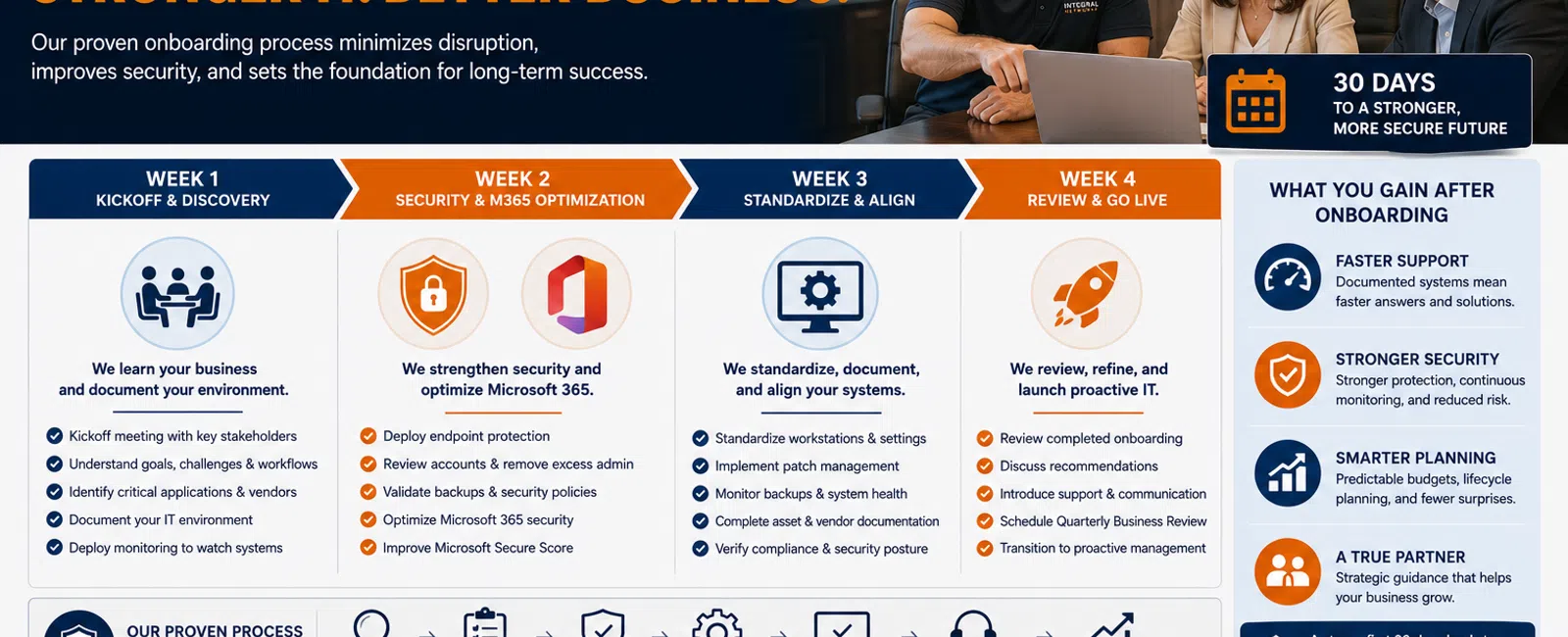
What Happens During Your First 30 Days with a New IT Provider?
Changing IT providers can feel intimidating.
One of the first questions we hear from prospective clients is:
"What's the transition actually going to look like?"
It's a fair concern.
You've likely spent years building your technology environment. Email, file storage, security, cloud applications, accounting software, legal software, printers, phones—it all has to continue working.
The good news is that switching IT providers doesn't have to be disruptive.
With the right onboarding process, the transition should improve your environment while minimizing interruptions to your staff.
At Integral Networks, we've developed a structured onboarding process that helps businesses transition smoothly while strengthening security, documenting systems, and laying the foundation for long-term success.
Here's what you can expect during your first 30 days.
Week One: Kickoff Meeting & Business Discovery
Every successful project starts with understanding the business—not just the technology.
Rather than jumping straight into technical work, we begin with a kickoff meeting, preferably in person whenever possible.
During this meeting we meet with business owners, managers, and key employees to learn how your company operates.
We discuss:
- Current technology frustrations
- Business goals
- Critical applications
- Key vendors
- Existing IT concerns
- Employee workflows
- Communication expectations
This meeting allows us to understand what success looks like before making technical changes.
Technology should support your business—not force your business to adapt to technology.
Week One: Documentation & Discovery
After the kickoff meeting, we begin documenting your environment.
One of the biggest problems we encounter with new clients is incomplete or outdated documentation.
Before we can effectively support your business, we need to understand everything connected to your network.
Our discovery process includes documenting:
- Servers
- Workstations
- Firewalls
- Network switches
- Wireless infrastructure
- Printers
- Internet providers
- Cloud services
- Microsoft 365
- Backup systems
- Business applications
At the same time, we deploy our monitoring platform so we can begin proactively watching the health of your environment.
Week Two: Security Standardization
Once discovery is complete, we begin implementing Integral Networks' security standards.
Every business deserves a consistent security posture.
Rather than supporting dozens of different security configurations, we standardize our clients using proven technologies and best practices.
This includes:
- Deploying endpoint protection
- Configuring security monitoring
- Reviewing administrative accounts
- Removing unnecessary local administrator rights
- Validating backups
- Reviewing security policies
- Confirming device compliance
For Microsoft 365 environments, we also verify that Business Premium licensing is in place so your organization can take advantage of Microsoft's advanced security capabilities.
Week Two: Microsoft 365 Optimization
Microsoft 365 has become the center of business productivity for many organizations.
Unfortunately, many companies only use a fraction of its security features.
During onboarding, we perform a comprehensive review of your Microsoft 365 environment.
This includes:
- User accounts
- Licensing
- Multi-Factor Authentication
- Exchange Online
- SharePoint
- Teams
- OneDrive
- Administrative permissions
- Identity protection
We also review your Microsoft Secure Score and remediate security recommendations that make sense for your organization.
Our goal isn't simply increasing a number.
Our goal is improving your overall security posture while maintaining a productive user experience.
Week Three: Standardizing Your Environment
As onboarding continues, we begin bringing your technology into alignment with our operational standards.
This creates consistency across your environment while making future support faster and more efficient.
Examples include:
- Standard workstation configurations
- Monitoring deployment
- Patch management
- Asset documentation
- Backup monitoring
- Vendor documentation
- Security verification
This step reduces surprises later because every supported device follows the same operational standards.
Week Four: Final Review & Go Live
Before onboarding concludes, we schedule a wrap-up meeting with your leadership team.
During this meeting we review:
- Completed onboarding activities
- Security improvements
- Remaining recommendations
- Current technology risks
- Future projects
- Support procedures
We'll also explain how to contact our support team, introduce ongoing communication processes, and schedule your first Quarterly Business Review.
At this point, your organization officially transitions into proactive managed services.
What Changes After Onboarding?
Many clients notice improvements almost immediately.
Common benefits include:
Faster Support
Because your environment is fully documented and standardized, technicians spend less time searching for answers and more time solving problems.
Better Security
Improved Microsoft 365 security.
Endpoint protection.
Email security.
Continuous monitoring.
All working together to reduce risk.
Better Planning
Instead of reacting to technology failures, your business begins planning ahead.
Hardware replacements become predictable.
Budgets become easier.
Technology supports business growth instead of slowing it down.
A True Technology Partner
Managed IT isn't just about fixing computers.
It's about having a trusted advisor who understands your business and helps you make smarter technology decisions over time.
Why a Structured Onboarding Process Matters
A successful onboarding process isn't simply about taking over IT support.
It's about building a strong foundation.
Businesses with documented systems, standardized security, proactive monitoring, and strategic planning experience fewer surprises, faster support, and a more stable technology environment.
That's why we invest so much effort into getting the first 30 days right.
Final Thoughts
Switching IT providers shouldn't be stressful.
With the right process, your business can improve security, reduce downtime, and establish a stronger technology foundation without disrupting day-to-day operations.
Whether you're a law firm, engineering company, manufacturer, financial services firm, or another growing business, the first month sets the tone for the entire relationship.
Choose a provider with a clear plan—not one that simply says, "We'll take care of it."
Supporting Businesses Across Northern California & Northern Nevada
Integral Networks helps organizations throughout Sacramento, Roseville, Rocklin, Folsom, Elk Grove, Woodland, Stockton, Modesto, Reno, Sparks, and Carson City transition to proactive managed IT services with minimal disruption. Whether you're replacing an underperforming IT provider or looking for stronger cybersecurity and strategic guidance, a structured onboarding process makes all the difference.
Ready to Make the Switch?
If you're considering changing IT providers, we'd be happy to walk you through our onboarding process and answer any questions before you make a decision.
A little planning today can prevent a lot of frustration tomorrow.
Schedule a complimentary IT assessment with Integral Networks.
Related Articles
How Much Does Managed IT Cost for Law Firms in Northern California? (2026 Pricing Guide)
What's Included in Flat-Rate Managed IT Services? Everything Your Business Should Expect
The 7 Biggest IT Problems We Find When Taking Over a New Law Firm