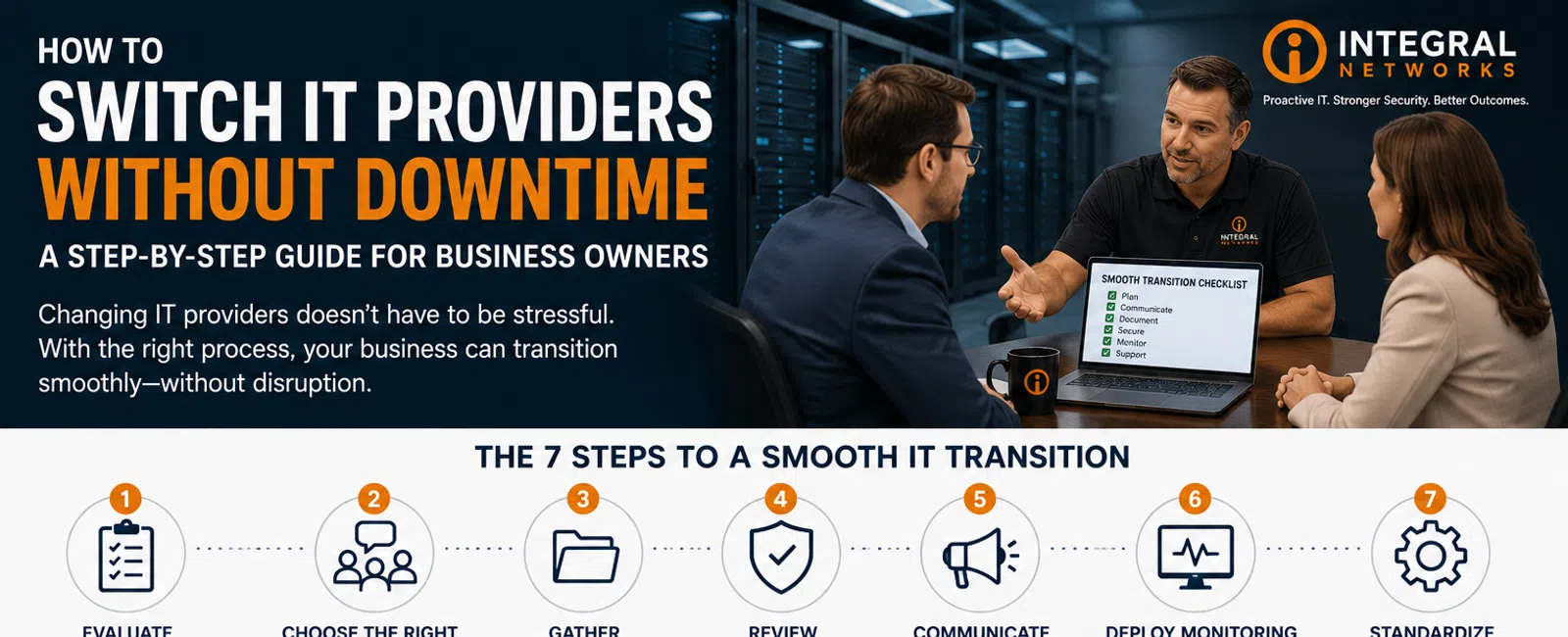
How to Switch IT Providers Without Downtime: A Business Owner's Guide
Making the decision to leave your current IT provider is often the easy part.
The difficult question is:
"How do we actually switch without breaking everything?"
If you've been working with the same IT company for several years, it's natural to worry about losing access to email, disrupting employees, or discovering critical information that was never documented.
Fortunately, changing Managed Service Providers (MSPs) doesn't have to be stressful.
With the right planning and the right onboarding process, most businesses transition with little to no disruption to daily operations.
If you're considering switching IT providers, here's what you should expect—and how to make the transition as smooth as possible.
Why Businesses Change IT Providers
After speaking with business owners throughout Northern California, we find that the reasons for switching are remarkably consistent.
Most organizations aren't looking for the cheapest provider.
They're looking for a better experience.
The most common reasons include:
- Slow response times
- Poor communication
- Weak cybersecurity
- Lack of strategic planning
- Constant surprise invoices
- No technology roadmap
- Frustration with recurring issues
Technology should help your business grow—not become another problem to manage.
Step 1: Evaluate Your Current Environment
Before changing providers, take a step back and understand your current environment.
Ask yourself:
- Do we know where all of our passwords are?
- Is our Microsoft 365 tenant secure?
- Do we have current network documentation?
- Are backups being monitored?
- Is anyone planning for future technology needs?
Many businesses discover they don't have clear answers to these questions until they begin evaluating a new IT partner.
Step 2: Choose a Provider with a Defined Onboarding Process
One of the biggest differences between MSPs is what happens after you sign the agreement.
Ask every provider to explain their onboarding process.
If the answer is simply, "We'll take care of everything," ask for more detail.
A quality onboarding process should include:
- Business discovery
- Documentation
- Network assessment
- Security review
- Microsoft 365 review
- Monitoring deployment
- User communication
- Final transition meeting
The more structured the process, the smoother the transition is likely to be.
Step 3: Gather Documentation
Your new provider will need access to information about your environment.
Examples include:
- Domain registrar
- Microsoft 365 tenant
- Internet providers
- Firewall credentials
- Server information
- Network equipment
- Software licensing
- Backup systems
Don't panic if everything isn't available.
One of the first things a good MSP does is help recreate missing documentation.
Step 4: Review Your Security
Changing providers is the perfect opportunity to improve your security posture.
At Integral Networks, onboarding includes reviewing Microsoft 365 security, endpoint protection, administrative permissions, backup health, and overall security standards.
Rather than simply inheriting existing configurations, we bring clients into a standardized environment designed to improve both security and supportability.
Step 5: Communicate with Employees
One mistake many businesses make is forgetting to communicate with employees.
Your staff should know:
- Who their new IT provider is
- How to request support
- What changes to expect
- When maintenance may occur
- Who to contact if they have questions
Clear communication reduces confusion and builds confidence during the transition.
Step 6: Deploy Monitoring Before Problems Occur
One of the first technical tasks during onboarding should be deploying monitoring tools.
Monitoring allows your new IT provider to:
- Identify hardware issues
- Monitor backups
- Track system health
- Detect security concerns
- Respond proactively
Rather than waiting for employees to report problems, monitoring provides visibility into the health of your environment.
Step 7: Standardize Your Environment
Supporting every client differently creates unnecessary complexity.
That's why successful MSPs standardize.
This often includes:
- Microsoft 365 Business Premium
- Endpoint protection
- Email security
- Patch management
- Backup monitoring
- Device configuration
- Documentation standards
Standardization leads to faster support, stronger security, and a better overall client experience.
Common Concerns About Switching
"Will we lose email?"
No.
When properly planned, Microsoft 365 continues operating throughout the transition.
"Will employees notice?"
In most cases, very little changes from the user's perspective.
The biggest difference is often improved support.
"What if the previous IT company won't cooperate?"
Unfortunately, this happens occasionally.
An experienced MSP knows how to work through these situations while minimizing disruption.
Professional providers focus on helping the client—not creating unnecessary conflict.
"How long does onboarding take?"
Most organizations complete onboarding within approximately 30 days.
The exact timeline depends on the size and complexity of the environment.
How Integral Networks Handles Transitions
Every new client follows a structured onboarding process that includes:
Kickoff Meeting
We learn about your business before making technical changes.
Discovery
We document your environment and deploy monitoring.
Security Standardization
We review Microsoft 365, deploy security tools, and improve your security posture.
Go Live
We review completed work, introduce ongoing support, and begin proactive managed services.
This structured process minimizes disruption while building a stronger foundation for the future.
Final Thoughts
Changing IT providers doesn't have to be stressful.
With proper planning, clear communication, and a structured onboarding process, businesses can improve security, reduce downtime, and establish a more productive relationship with their new technology partner.
If your current provider isn't delivering the level of service your business deserves, don't assume you're stuck.
A smooth transition is possible—and often easier than business owners expect.
Supporting Businesses Across Northern California & Northern Nevada
Integral Networks helps organizations throughout Sacramento, Roseville, Rocklin, Folsom, Elk Grove, Woodland, Stockton, Modesto, Reno, Sparks, and Carson City transition to proactive managed IT services with minimal disruption. Whether you're replacing an underperforming IT provider or looking for stronger cybersecurity and strategic guidance, a structured onboarding process makes all the difference.
Ready to Explore Your Options?
If you're considering changing IT providers, we'd be happy to answer your questions, explain our onboarding process, and provide an honest assessment of your current environment.
There's no pressure—just practical advice from a team that's helped businesses make this transition successfully.
Schedule your complimentary IT assessment today.
Related Articles
How Much Does Managed IT Cost for Law Firms in Northern California? (2026 Pricing Guide)
What's Included in Flat-Rate Managed IT Services? Everything Your Business Should Expect
The 7 Biggest IT Problems We Find When Taking Over a New Law Firm
What Happens During Your First 30 Days with a New IT Provider?