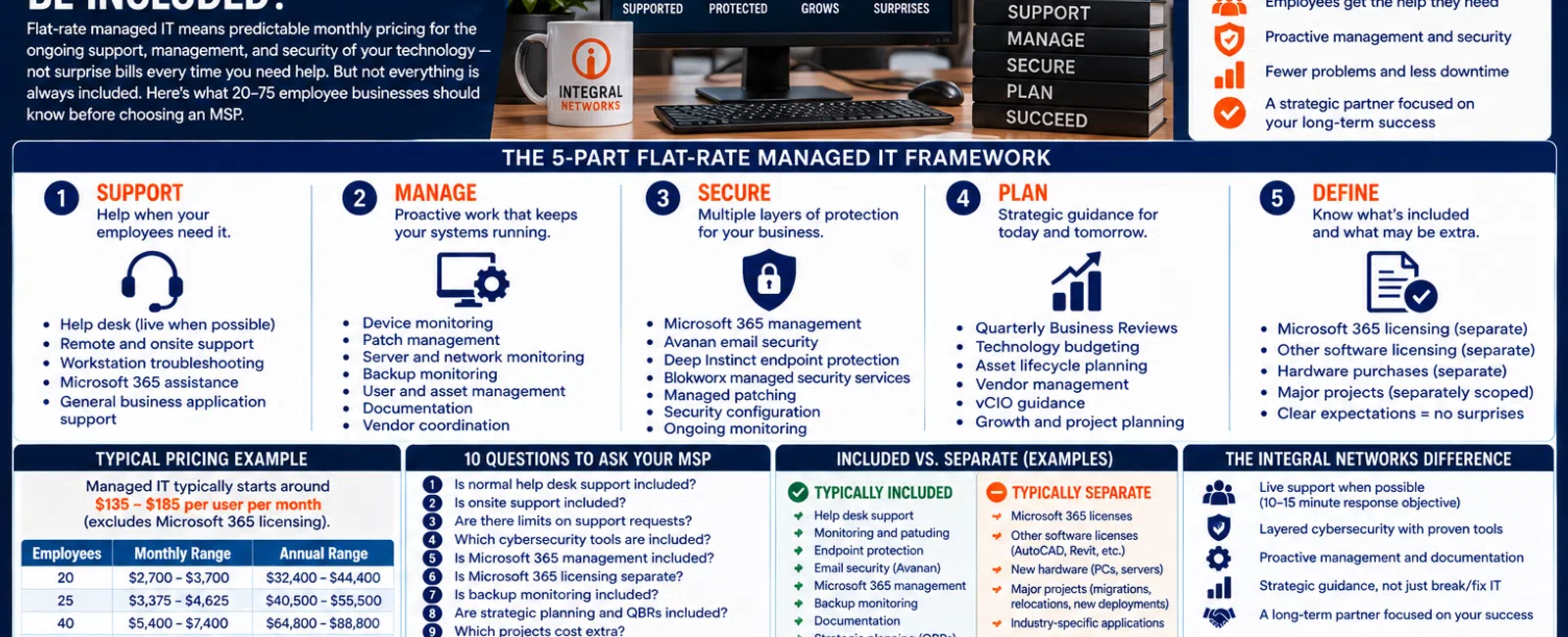
What Does Flat-Rate Managed IT Really Mean—and What Should Be Included?
For a business with 20 to 75 employees, flat-rate managed IT should mean that the normal, ongoing work required to support and manage your technology is covered by a predictable monthly fee rather than generating another hourly invoice every time an employee needs help.
At Integral Networks, managed IT typically starts around $135-$185 per user per month, excluding Microsoft 365 licensing.
But "flat-rate" doesn't necessarily mean every technology expense your company will ever have is included.
The important question is:
What's included in the monthly fee, what isn't, and can your provider explain the difference before you receive the bill?
Use this five-part framework:
Support. Manage. Secure. Plan. Define.
The 5-Part Flat-Rate Managed IT Framework
A useful managed-services agreement should make five things clear.
1. SUPPORT
What happens when employees need technical help?
2. MANAGE
What technology is proactively maintained between support requests?
3. SECURE
Which cybersecurity protections and management services are included?
4. PLAN
What strategic planning, budgeting, and lifecycle management does the provider deliver?
5. DEFINE
What falls outside the agreement and may create an additional charge?
If an MSP can't clearly explain those five areas, comparing its monthly price with another provider becomes difficult.
1. SUPPORT: Employee Help Should Be Part of the Monthly Service
Let's start with the part employees notice most.
Something stops working.
They need help.
Under an hourly support model, every interaction may create a charge.
That can produce an unhealthy behavior:
Employees hesitate before contacting IT.
They try to fix problems themselves.
They ask coworkers.
They tolerate recurring problems because:
"I don't want us to get another IT bill."
We don't want that.
Under our flat-rate model, normal employee support is part of the managed relationship.
That includes areas such as:
- Help desk
- Remote support
- Onsite support
- Workstation troubleshooting
- Microsoft 365 assistance
- General business application troubleshooting
Whenever possible, an Integral Networks technician answers the phone live.
If someone isn't immediately available, our general response objective is 10-15 minutes.
That's a response objective—not a promise that every technical problem can be resolved in 15 minutes.
But employees should know someone is engaged.
Why Unlimited Support Isn't the Same as Unlimited Everything
This distinction matters.
If an employee has an Outlook problem, that's support.
If the company decides to relocate its entire office, replace infrastructure, and migrate several business applications, that's a project.
Both involve IT.
They're not necessarily the same type of work.
A well-defined managed-services agreement should make that distinction understandable before work begins.
The objective isn't hiding exclusions.
It's creating predictable expectations.
2. MANAGE: You're Paying for Work That Happens Between Tickets
This is where businesses sometimes misunderstand managed IT.
If you're evaluating an MSP solely by the number of support tickets it closes, you're missing a significant part of the service.
A mature MSP should be working on the environment even when employees aren't calling.
That may include:
- Device monitoring
- Patch management
- Server monitoring
- Network monitoring
- Backup monitoring
- Microsoft 365 administration
- Documentation
- Asset management
- User management
- Vendor coordination
The best IT problem is often the one employees never experience.
Consider Patching
An employee doesn't submit a ticket saying:
"Please install security updates on my workstation tonight."
That's management work.
Consider Monitoring
An employee doesn't call because a server is approaching a capacity problem they don't know exists.
Monitoring may identify the issue first.
That's management work.
Consider Documentation
Employees don't normally request that network diagrams and vendor information remain current.
But good documentation makes future support faster.
That's management work.
Flat-rate managed IT should account for this proactive work—not just reactive help desk activity.
3. SECURE: Cybersecurity Shouldn't Be an Afterthought
Twenty years ago, an IT agreement could focus primarily on keeping computers running.
Modern businesses need more.
For organizations with 20-75 employees, cybersecurity should be integrated into the managed relationship.
At Integral Networks, our standardized managed security approach includes technologies and services such as:
- Microsoft 365 Business Premium
- Deep Instinct endpoint protection
- Avanan email security
- Blokworx managed security services
- Managed patching
- Microsoft 365 security configuration
- Ongoing monitoring
Microsoft 365 licensing itself is separate from our managed IT pricing.
That's an example of an important pricing distinction.
Included Service vs. Separate License
Managing and securing Microsoft 365: part of the managed IT relationship.
Purchasing the Microsoft 365 license: separate.
The same concept may apply to other third-party applications and subscriptions.
Your MSP should make these distinctions clear.
4. PLAN: Strategic IT Shouldn't Be Another Hourly Surprise
This is one of the biggest differences between basic outsourced support and mature managed IT.
Someone needs to think beyond today's tickets.
Leadership needs answers to questions like:
- Which computers need replacement next year?
- Is our firewall approaching replacement?
- What technology projects are coming?
- What should we budget?
- Where are our biggest cybersecurity risks?
- Is our environment ready for company growth?
- Are we paying for unnecessary software?
- Which vendors need attention?
At Integral Networks, our managed IT model includes strategic functions such as:
- Quarterly Business Reviews
- Asset lifecycle management
- Technology budgeting
- Vendor management
- Technology roadmaps
- vCIO guidance
Those conversations shouldn't happen only after something breaks.
5. DEFINE: What Might Not Be Included?
This is where every prospective MSP client should pay attention.
"Flat-rate" shouldn't be interpreted as:
Every technology-related purchase and project is free forever.
There may be costs outside the recurring managed-services agreement.
Depending on the environment and agreement, examples can include:
Microsoft 365 Licensing
We require Microsoft 365 Business Premium for managed clients, but the licensing is separate from our managed IT pricing.
Other Software Licensing
Examples could include:
- NetDocuments
- Worldox
- AutoCAD
- Revit
- Bluebeam
- SolidWorks
- Adobe
- Industry-specific applications
Hardware
Your managed IT fee doesn't mean new computers, servers, switches, or other hardware suddenly have no cost.
Major Projects
Some large standalone projects may need to be scoped separately depending on the work involved.
Examples might include:
- Office relocations
- Major migrations
- Large infrastructure replacements
- Significant new deployments
- Other substantial project work
The exact scope should be discussed before work begins.
That's the important part.
Predictability doesn't mean nothing ever costs extra. It means you shouldn't be constantly surprised.
What Does $135-$185 Per User Actually Look Like?
Using Integral Networks' typical managed IT range:
| Employees | Monthly Managed IT | Annual Managed IT |
|---|---|---|
| 20 | $2,700-$3,700 | $32,400-$44,400 |
| 25 | $3,375-$4,625 | $40,500-$55,500 |
| 40 | $5,400-$7,400 | $64,800-$88,800 |
| 50 | $6,750-$9,250 | $81,000-$111,000 |
| 75 | $10,125-$13,875 | $121,500-$166,500 |
Microsoft 365 licensing is additional.
These numbers are useful for budgeting.
But don't compare MSPs using the price column alone.
Two providers can both quote:
$150 per user
while delivering very different services.
The $150 vs. $150 Problem
Imagine two MSP proposals.
MSP A — $150 Per User
Includes:
- Help desk
- Remote support
- Basic monitoring
Then bills separately for:
- Onsite support
- Security products
- Strategic consulting
- Projects
- After-hours work
- Other services
MSP B — $150 Per User
Includes a broader combination of:
- Help desk
- Remote support
- Onsite support
- Monitoring
- Patching
- Cybersecurity management
- Microsoft 365 management
- Asset management
- Vendor management
- Strategic planning
Those aren't equivalent offers simply because the per-user price is identical.
This is why buyers should ask:
"What do we receive for the monthly investment?"
not simply:
"What's your per-user price?"
The 10 Questions to Ask About Flat-Rate Pricing
Before signing a managed-services agreement, ask:
- Is normal help desk support included?
- Is onsite support included?
- Are there limits on the number of support requests?
- Which cybersecurity tools and services are included?
- Is Microsoft 365 management included?
- Is Microsoft 365 licensing included or separate?
- Is backup monitoring included?
- Are Quarterly Business Reviews and strategic planning included?
- Which types of projects cost extra?
- What are the most common reasons a client receives a charge outside the monthly agreement?
That tenth question is especially useful.
Don't ask only:
"Are there additional charges?"
Ask:
"What additional charges do your clients actually encounter?"
That usually produces a much more useful conversation.
What About Onsite Support?
This is worth asking directly because MSP models differ.
Integral Networks combines remote support with onsite service when physical assistance is necessary.
That matters to us because we focus on two primary service areas:
Greater Sacramento
and
Northern Nevada.
Remote support can solve a large percentage of modern IT problems.
But sometimes somebody needs to physically touch the equipment.
Your managed-services agreement should make clear how onsite support works and whether it changes the cost.
Why Flat-Rate Creates Better Incentives
Consider an hourly IT relationship.
A recurring problem occurs every month.
The provider fixes it every month.
The provider bills every month.
Financially, the recurring problem isn't necessarily bad for the provider.
Now consider a flat-rate managed relationship.
The same problem occurs every month.
The provider isn't generating another hourly invoice each time.
There's a stronger incentive to ask:
"Why does this keep happening, and how do we stop it?"
That's the alignment we want.
Fewer problems are better for the client.
And fewer problems are better for us.
Example: 40-Person Professional Services Company
Consider a hypothetical company with 40 employees.
At our typical range, managed IT would be approximately:
$5,400-$7,400 per month
or:
$64,800-$88,800 per year.
Leadership should be able to identify what that investment provides.
For example:
SUPPORT
Employees can get help when technology isn't working.
MANAGEMENT
Devices, infrastructure, patches, Microsoft 365, backups, and documentation receive ongoing attention.
SECURITY
The environment has standardized security layers.
PLANNING
Leadership receives budgeting, lifecycle, and roadmap guidance.
Then the organization separately plans for things such as:
- Microsoft 365 licensing
- Industry applications
- New hardware
- Major projects
That's a much more useful budget than simply creating one category called:
IT.
Flat-Rate Doesn't Eliminate Your IT Budget
This is another misconception.
Moving to flat-rate managed IT doesn't mean technology spending becomes one monthly invoice.
You still need to budget for:
- Managed IT
- Microsoft 365
- Business software
- Hardware lifecycle
- Projects
- Growth
The managed-services fee makes one significant portion of technology spending predictable.
Strategic planning should help make the other portions more predictable too.
The Surprise-Invoice Test
Here's a simple way to evaluate your current arrangement.
Look at the last six months of IT invoices.
Ask:
How many times did leadership receive a charge it wasn't expecting?
Then categorize those charges.
Were they:
Planned Hardware?
That's normal if leadership knew about it.
Software Licensing?
Again, normal if it was expected.
Planned Project Work?
Potentially normal if scope and cost were discussed.
Ordinary Employee Support?
If supposedly flat-rate support regularly generates unexpected additional charges, ask why.
Miscellaneous Charges Nobody Understands?
That's a problem.
The goal isn't necessarily zero invoices outside the monthly fee.
The goal is zero confusion about why those invoices exist.
Flat-Rate IT Should Make Employees More Comfortable Calling Support
There's also an employee-experience benefit.
We don't want someone spending an hour struggling with Outlook because they're worried calling IT costs $200.
Their time has value too.
If a technology problem is preventing an employee from working effectively, they should contact support.
At Integral Networks, whenever possible, a technician answers the phone live.
Otherwise, our general response objective is 10-15 minutes.
Fast support plus predictable pricing creates a better incentive:
Ask for help when you need it.
What Should a Good MSP Proposal Show You?
A managed-services proposal shouldn't require a forensic accountant to understand it.
Look for clear explanations of:
- Monthly pricing
- Included support
- Onsite support
- Security
- Microsoft 365 management
- Monitoring
- Backup responsibilities
- Strategic services
- Licensing
- Hardware
- Project exclusions
If something isn't clear, ask.
The MSP should be able to explain the agreement in ordinary business language.
Flat-Rate Managed IT for Greater Sacramento Businesses
Integral Networks supports growing organizations throughout the Greater Sacramento region, including Sacramento, Roseville, Rocklin, Folsom, Elk Grove, Woodland, Stockton, Modesto, and surrounding communities.
Our primary managed IT focus is businesses with 20 or more employees, including law firms, engineering and architectural firms, manufacturers, financial services organizations, and other technology-dependent businesses.
Sacramento, CA: (916) 626-4000
Flat-Rate Managed IT for Northern Nevada Businesses
Our second primary service area is Northern Nevada, including Reno, Sparks, Carson City, and surrounding communities.
Our goal in both markets is the same: responsive support, stronger cybersecurity, proactive management, and more predictable technology spending.
Reno, NV: (775) 446-4100
Final Thoughts
Flat-rate managed IT doesn't mean:
"Everything technology-related is free."
It should mean:
The normal ongoing work of supporting and managing your environment is predictable.
Use the five-part framework:
Support.
Manage.
Secure.
Plan.
Define.
Know what's included.
Know what's separate.
Know what could generate an additional charge.
And know what you're receiving for the monthly investment.
Because when comparing MSP proposals, the cheapest per-user number doesn't necessarily represent the lowest cost—or the best value.
The better question is:
"What does this monthly investment actually do for our business?"
Ready for a Second Opinion?
If you're comparing managed IT proposals—or you're currently paying a supposedly flat monthly fee but still receiving unexpected invoices—Integral Networks can help you understand what a more predictable managed IT relationship looks like.
We provide flat-rate managed IT, cybersecurity, Microsoft 365 management, asset lifecycle planning, vendor management, responsive support, and strategic IT guidance for growing businesses throughout the Greater Sacramento region and Northern Nevada.
Related Articles
What's Included in Flat-Rate Managed IT Services? Everything Your Business Should Expect
How Much Should a 20-75 Employee Business Budget for IT Each Year?
When Should a 20-75 Employee Business Hire an MSP Instead of Internal IT?
How Long Should It Take Your IT Provider to Respond to a Support Request?